Bangladesh Woven Garments Industry Buying Guide—discover how international buyers can source quality woven apparel from Bangladesh with confidence. Dress Merchant, a leading garments buying house and fashion buying agent, provides expert support in supplier sourcing, production management, quality control, and export. From shirts and trousers to complete woven collections, we connect buyers with reliable manufacturing solutions for competitive pricing, consistent quality, and timely delivery.
Thank you for reading this post, don't forget to subscribe!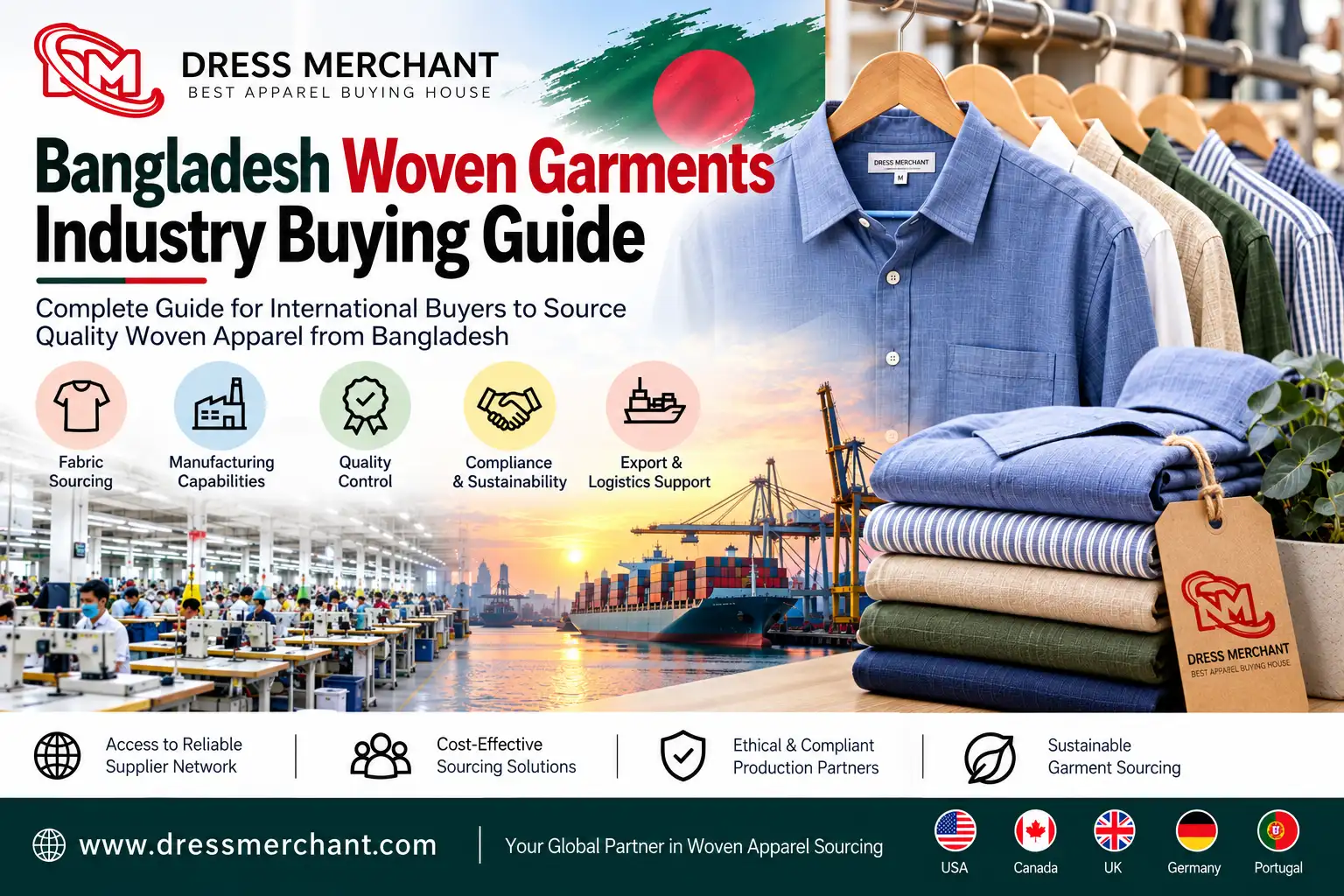
Why Choose Bangladesh for Woven Garment Sourcing?
Bangladesh has become an important sourcing destination for international apparel buyers looking for competitive pricing, experienced manufacturers, and large-scale production capabilities. The country has a well-established garment manufacturing ecosystem supported by textile mills, factories, accessories suppliers, washing facilities, packaging companies, and professional buying houses.
For buyers interested in woven products such as shirts, trousers, jackets, dresses, skirts, workwear, uniforms, and other apparel, Bangladesh offers access to manufacturers with experience serving international markets. Many factories are accustomed to working with overseas buyers and following detailed specifications related to fabric, measurements, workmanship, labeling, packaging, and shipment requirements.
Another advantage is the depth of the local supply chain. Buyers can source fabrics and garment accessories within Bangladesh while coordinating production through experienced manufacturers or a professional sourcing partner. This can make communication, sampling, quality control, and production follow-up more efficient.
For a new international buyer, however, choosing Bangladesh should not simply be based on the lowest quotation. Factory capability, product specialization, quality systems, compliance, production capacity, communication, and delivery performance should all be evaluated before placing an order.
Overview of the Bangladesh Woven Garments Industry
The Bangladesh woven garments industry forms an important part of the country’s broader apparel manufacturing sector. Woven garments are produced using woven fabrics, where yarns are interlaced to create a stable and structured textile construction.
Common woven fabrics used by Bangladeshi manufacturers include cotton, polyester, viscose, linen blends, twill, poplin, oxford, denim, canvas, and various blended fabrics. The appropriate material depends on the product’s design, target market, price point, performance requirements, and season.
Bangladesh’s garment supply chain includes manufacturers of different sizes and specializations. Some factories focus on large-volume basic products, while others specialize in fashion garments, uniforms, workwear, outerwear, or particular fabric constructions.
International buyers can therefore work with suppliers according to their individual requirements rather than following a one-size-fits-all sourcing model.
When evaluating a potential supplier, buyers should consider:
- Product specialization and factory capability
- Monthly production capacity
- Fabric and trim sourcing capabilities
- Sampling and product development facilities
- Quality-control procedures
- Social and environmental compliance
- Experience with international customers
- Lead-time management
- Export and documentation capabilities
Understanding these factors before supplier selection can help new buyers reduce sourcing risks and establish a more reliable production relationship.
Top Woven Garments Manufactured in Bangladesh
Bangladesh manufacturers produce a broad range of woven apparel for international brands, retailers, wholesalers, and private-label businesses. Product availability can vary from factory to factory, so buyers should select suppliers based on their specific product requirements.
Popular woven garment categories include:
Woven Shirts
Woven shirts are among the most commonly sourced products. Manufacturers can produce formal shirts, casual shirts, overshirts, work shirts, button-down shirts, and fashion styles using fabrics such as poplin, oxford, cotton, viscose, and blended materials.
Woven Trousers and Pants
Factories manufacture various trousers and pants, including formal trousers, chinos, cargo pants, casual pants, workwear trousers, and fashion bottoms. Buyers can specify fabric composition, construction, washing, trims, measurements, and finishing requirements.
Dresses and Skirts
Woven dresses and skirts are produced in different silhouettes, fabrics, prints, and finishing techniques. Buyers can develop seasonal collections according to their target market and customer profile.
Jackets and Outerwear
Depending on factory specialization, Bangladesh suppliers can produce lightweight jackets, overshirts, utility jackets, fashion outerwear, and other structured garments.
Workwear and Uniforms
Bangladesh is also capable of producing woven workwear, uniforms, industrial garments, and corporate apparel where durability, consistent sizing, and functional construction are important.
Before selecting a manufacturer, international buyers should provide a clear tech pack or product specification. This allows the supplier to assess construction requirements and prepare a more accurate quotation and sample.
How to Find Reliable Woven Garment Manufacturers in Bangladesh
Finding a suitable woven garment manufacturer in Bangladesh requires more than searching online and selecting the supplier offering the lowest price.
A professional sourcing process should begin by defining your product requirements. Prepare information such as product category, target quantity, fabric composition, size range, color requirements, expected quality level, packaging specifications, and target delivery date.
Once your requirements are clear, shortlist manufacturers with relevant product experience.
When evaluating potential suppliers, consider asking for:
- Company and factory profile
- Product portfolio
- Relevant production experience
- Sample development capability
- Production capacity
- Quality-control procedures
- Compliance documentation where relevant
- Previous export-market experience
- Production lead-time estimates
- References or buyer experience where available
It is also useful to evaluate how quickly and accurately the supplier responds to technical questions. Clear communication during the initial sourcing stage can be an important indicator of how smoothly product development and production follow-up may proceed.
For new buyers who do not have an established supplier network in Bangladesh, working with an experienced buying house or sourcing agent can simplify the process. A buying house can help identify suitable factories, compare quotations, coordinate samples, monitor production, and communicate with suppliers on behalf of the buyer.
Key Factors to Consider When Choosing a Bangladesh Buying House
A professional Bangladesh buying house can act as a bridge between international buyers and local manufacturers. For first-time buyers, this support can be particularly useful because sourcing involves multiple stages rather than simply placing a factory order.
When selecting a buying house, examine its experience, sourcing network, product expertise, communication process, and quality-control approach.
A suitable sourcing partner should understand your product requirements and help match them with appropriate factories rather than sending the same inquiry to every available supplier.
Key areas to evaluate include:
Factory network: Does the buying house have access to manufacturers capable of producing your specific woven products?
Product knowledge: Can the team understand tech packs, fabrics, measurements, trims, construction, and finishing requirements?
Quality management: What procedures are used for sample approval, inline inspection, and final inspection?
Production follow-up: How does the company monitor production progress and address delays or quality issues?
Communication: Can the buying house provide clear and timely updates throughout the order?
Export coordination: Can the sourcing partner assist with documentation, shipment coordination, and other export-related processes?
For international buyers, the objective should be to establish a transparent sourcing relationship where expectations, prices, specifications, quality standards, and delivery schedules are clearly documented.
Woven Garment Sourcing Process in Bangladesh: Step-by-Step Guide
For new buyers, understanding the woven garment sourcing process in Bangladesh can make the entire purchasing journey easier to manage.
1. Define Your Product Requirements
Start with a clear product brief containing the design, fabric, measurements, colors, trims, labeling, packaging, quantity, and expected delivery date.
2. Identify Suitable Suppliers
Research manufacturers or work with a Bangladesh buying house to identify factories with relevant product capabilities.
3. Request Quotations
Send the same technical requirements to shortlisted suppliers so quotations can be compared on a consistent basis.
4. Develop Samples
The supplier develops samples based on your specifications. Multiple sample revisions may be necessary before approval.
5. Confirm Price and Order Details
Once the product is approved, finalize pricing, quantity, payment terms, production timeline, packaging, inspection requirements, and shipping arrangements.
6. Begin Bulk Production
Production starts after all relevant approvals are completed. Buyers or their sourcing representatives should monitor production milestones.
7. Conduct Quality Inspection
Quality checks can be performed during production and before shipment according to the buyer’s requirements.
8. Prepare Shipment
After final approval, the supplier prepares the order for export, including required documentation and packaging.
A clearly defined process helps minimize misunderstandings and gives both the buyer and supplier a common framework for managing the order.
Quality Control Standards for Woven Garments in Bangladesh
Quality control is one of the most important considerations when sourcing woven garments internationally. A competitive price has limited value if the finished garments do not meet the buyer’s specifications.
Quality requirements should ideally be established before production begins. The buyer should clearly communicate acceptable standards for measurements, fabric composition, color, stitching, workmanship, appearance, trims, labeling, and packaging.
A typical quality-control process may include several stages.
Fabric inspection: Fabric can be checked for composition, color consistency, construction, defects, GSM, and other agreed specifications.
Sample approval: The production sample should be compared against the approved reference sample and technical specifications.
Inline inspection: Quality personnel can inspect garments during production to identify recurring defects before the entire order is completed.
Final inspection: Finished garments can be inspected before shipment according to the buyer’s agreed inspection procedure and acceptance criteria.
Buyers should also establish a clear measurement tolerance and defect classification system. Having these standards in writing helps the factory and buyer understand exactly what constitutes an acceptable finished product.
For new international buyers, partnering with a sourcing company that maintains structured quality-control procedures can make production management significantly easier.
Woven Garment Pricing, MOQ, and Production Lead Times
Understanding pricing is essential when developing a sourcing strategy in Bangladesh. However, the cheapest quotation does not necessarily represent the lowest overall sourcing cost.
Woven garment pricing can depend on numerous factors, including:
- Fabric type and composition
- Fabric consumption
- Garment construction
- Style complexity
- Number of trims and accessories
- Printing or embroidery
- Washing and finishing
- Order quantity
- Packaging requirements
- Quality specifications
- Delivery requirements
MOQ, or Minimum Order Quantity, can also vary considerably between manufacturers. A factory specializing in high-volume production may have different MOQ requirements from a supplier that works with smaller private-label orders.
Lead time should also be discussed early. Product development, fabric booking, sampling, approvals, bulk production, inspection, and shipment preparation all require time.
Instead of asking only, “What is your price?”, buyers should request a complete quotation based on the exact specifications and quantity. This creates a more meaningful comparison between suppliers.
A professional buying house can also help buyers compare factory quotations while considering product quality, production capability, and delivery requirements alongside price.
Sustainable and Ethical Woven Garment Sourcing in Bangladesh
Sustainability has become an increasingly important consideration for international apparel buyers. Buyers are paying greater attention to responsible manufacturing, resource efficiency, worker welfare, environmental management, and supply-chain transparency.
When sourcing woven garments from Bangladesh, buyers can discuss sustainability requirements with prospective suppliers from the beginning of the sourcing process.
Depending on the buyer’s market and product requirements, areas of consideration may include:
- Responsible fabric sourcing
- Recycled or preferred materials
- Water and energy management
- Waste reduction
- Responsible chemical management
- Worker safety
- Social compliance
- Ethical employment practices
- Packaging reduction
- Supply-chain transparency
It is important to distinguish between a supplier’s general sustainability claims and documented practices. Buyers should request relevant certifications, audit reports, policies, or other supporting documentation where appropriate.
Sustainable sourcing should also be treated as part of the overall product-development process rather than something added immediately before shipment.
For brands developing long-term sourcing programs, discussing environmental and social requirements at the beginning can help ensure that suppliers are selected according to the buyer’s standards.
How International Buyers Can Successfully Source Woven Garments from Bangladesh
Successful sourcing is ultimately about building a reliable process between the buyer, sourcing partner, and manufacturer.
For first-time international buyers, the most important step is to communicate product requirements clearly. A detailed tech pack, approved sample, measurement chart, fabric specification, color standard, labeling requirement, packaging instruction, and quality standard can significantly reduce misunderstandings.
Buyers should also avoid selecting suppliers based solely on quotation. A manufacturer with the right product expertise, quality system, capacity, and communication process may provide greater value over the course of a complete production cycle.
Regular communication is equally important. Production schedules, fabric status, sample approvals, inspection results, and shipment milestones should be documented and monitored.
Working with an experienced Bangladesh buying house can provide additional support throughout this process. A sourcing partner can help international buyers connect with appropriate manufacturers, negotiate commercial terms, coordinate product development, monitor production, and maintain quality-control procedures.
For companies entering the Bangladesh market for the first time, the goal should be to build a transparent, well-documented, and long-term sourcing relationship rather than simply completing a single order.
Dress Merchant supports international buyers with apparel sourcing, product development, production coordination, quality control, and export-related assistance in Bangladesh. With access to a broad network of manufacturing partners, the company can help buyers navigate the local apparel supply chain and develop woven garments according to their market requirements.
Conclusion: Bangladesh Woven Garments Industry Buying Guide
The Bangladesh Woven Garments Industry Buying Guide highlights the key factors international buyers should consider when sourcing woven apparel from Bangladesh. From fabric selection and product development to factory compliance, quality control, production management, pricing, and export coordination, choosing the right sourcing partner can make the entire buying process more efficient and reliable.
Bangladesh has a well-established apparel manufacturing ecosystem with experienced factories, skilled workers, competitive production capabilities, and strong export experience. However, successful sourcing is not only about finding a low-cost manufacturer. Buyers also need dependable communication, transparent production processes, consistent quality, timely delivery, and proper compliance throughout the order lifecycle.
This is where Dress Merchant can support international buyers. As an apparel buying house, buying agent, sourcing and export partner in Bangladesh, Dress Merchant helps buyers connect with suitable manufacturing partners and manage different stages of the sourcing process. From product development and supplier selection to production follow-up, quality inspection, and shipment coordination, our team works to simplify woven garment sourcing for overseas customers.
Whether you are sourcing woven shirts, trousers, dresses, jackets, uniforms, workwear, or other woven apparel, selecting the right buying house can help reduce sourcing risks and create a smoother supply chain. Dress Merchant combines Bangladesh’s manufacturing capabilities with professional sourcing and buying-house services to help international buyers develop reliable and long-term business relationships.
For buyers looking to source quality woven garments from Bangladesh, Dress Merchant is ready to assist with product sourcing, manufacturing coordination, quality management, and export support. Contact our team to discuss your requirements and explore suitable woven garment sourcing solutions from Bangladesh.