Sustainable Woven Clothing Buying Options From Bangladesh—discover responsible, quality-focused apparel sourcing with Dress Merchant. As a leading Garments Buying House and fashion buying agent, we connect international buyers with reliable manufacturers for sustainable woven clothing, production, quality control, and export. Source stylish, durable, and ethically produced apparel and Home Textiles from Bangladesh with confidence.
Thank you for reading this post, don't forget to subscribe!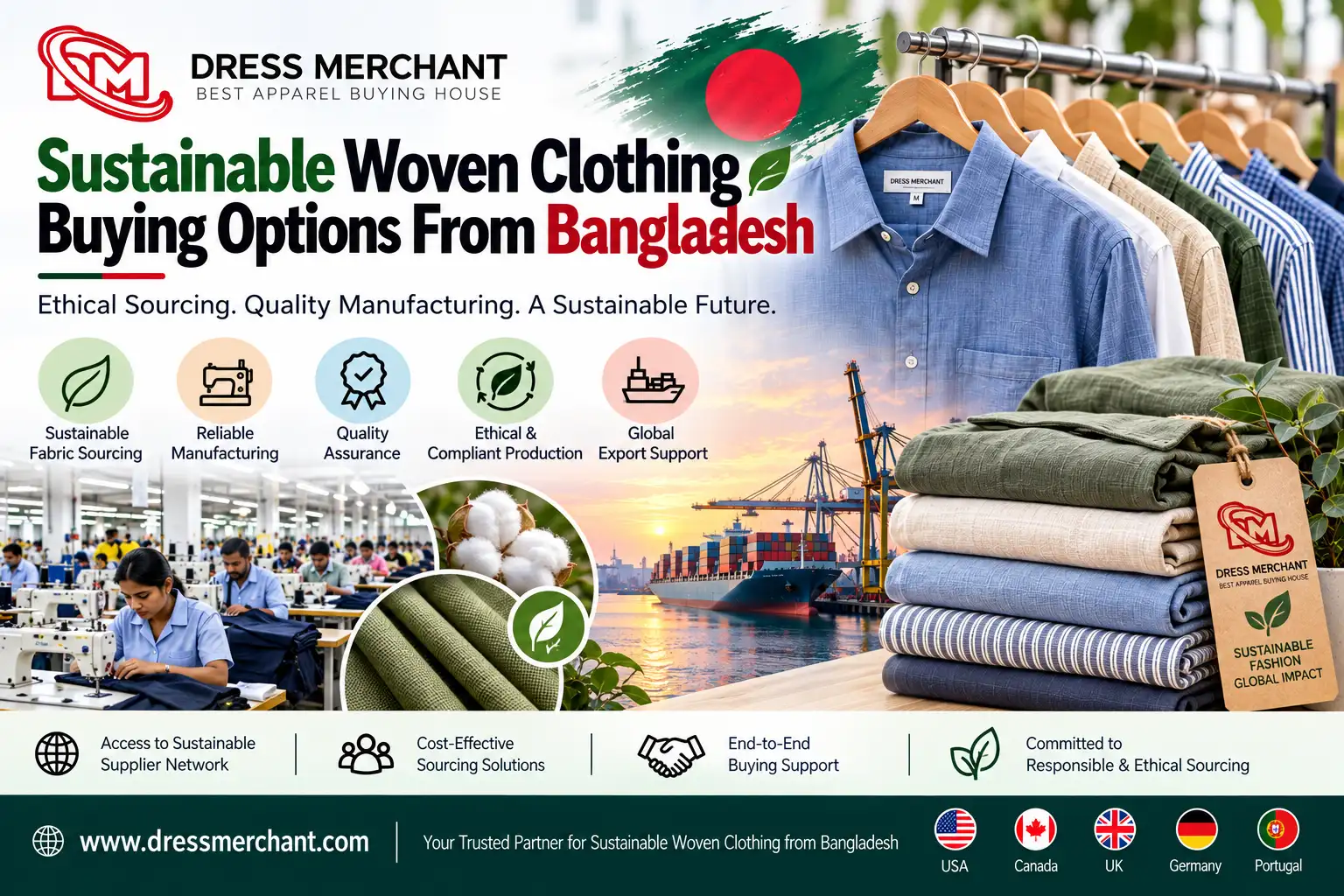
Why Choose Bangladesh for Sustainable Woven Clothing Sourcing?
Bangladesh has become an important sourcing destination for international buyers looking for quality, competitive pricing, and increasingly sustainable apparel production. The country has a well-established woven garment industry supported by experienced manufacturers, skilled workers, modern production facilities, and a strong export-oriented supply chain.
For buyers seeking sustainable woven clothing from Bangladesh, the sourcing landscape offers a wide range of options, including shirts, blouses, dresses, trousers, jackets, skirts, uniforms, and other woven apparel. International buyers can work directly with manufacturers or partner with an experienced apparel buying house to identify suitable suppliers, manage production, monitor quality, and coordinate export processes.
Sustainability is also becoming an increasingly important consideration in Bangladesh’s apparel sector. Manufacturers are adopting more responsible approaches to fabric sourcing, production efficiency, water and energy management, waste reduction, and compliance. Depending on the supplier and product requirements, buyers may also source garments made from organic, recycled, regenerated, or other preferred materials.
Another advantage is Bangladesh’s established export infrastructure. International buyers can benefit from an extensive network of textile mills, garment factories, accessories suppliers, inspection services, logistics providers, and sourcing professionals.
For new buyers, however, selecting the right supplier requires more than comparing prices. Production capability, quality standards, compliance, communication, lead times, sustainability requirements, and order flexibility should all be evaluated before placing an order.
Dress Merchant supports international buyers by connecting them with suitable manufacturing partners and coordinating key stages of the sourcing and production process. This allows buyers to explore reliable sustainable woven clothing buying options from Bangladesh without having to manage every part of the local supply chain independently.
Sustainable Woven Clothing Products Available From Bangladesh
Bangladesh offers a broad range of woven apparel products for international brands, retailers, wholesalers, and private-label businesses. Buyers can source both basic and fashion-oriented woven garments depending on their target market, design requirements, fabric specifications, and order volume.
Common sustainable woven clothing options include:
- Woven shirts and casual shirts
- Formal and office shirts
- Women’s blouses and tops
- Woven dresses
- Trousers and pants
- Skirts
- Shorts
- Jackets and lightweight outerwear
- Children’s woven clothing
- Workwear and uniforms
- Fashion and lifestyle apparel
- Private-label woven garments
Product development can be customized according to the buyer’s requirements. This may include fabric composition, GSM, weave structure, dyeing method, garment construction, trims, labels, packaging, measurements, colors, prints, embroidery, and finishing.
For sustainable collections, buyers can also specify preferred materials and production requirements at the development stage. Depending on availability and supplier capability, options may include organic cotton, recycled fibers, recycled polyester, linen, Tencel™ or other cellulosic fibers, and blended fabrics.
The right product selection depends on the buyer’s market and sustainability objectives. A sourcing partner can help evaluate available fabrics and manufacturing capabilities before production begins.
For new international buyers, starting with a clearly defined product specification is important. A detailed tech pack, fabric requirement, size chart, color references, artwork, packaging instructions, and quality expectations can help manufacturers provide more accurate quotations and samples.
Eco-Friendly Fabrics Used in Bangladesh’s Woven Garments Industry
Fabric selection is one of the most important considerations when developing sustainable woven apparel. The environmental characteristics of a garment depend not only on the finished product but also on the raw materials, manufacturing processes, dyeing, finishing, transportation, and end-of-life considerations.
International buyers sourcing woven garments from Bangladesh may explore several preferred-material options depending on the product and supplier.
Organic cotton can be considered by buyers seeking cotton products produced according to recognized organic standards. It is commonly used for shirts, dresses, trousers, and other woven apparel.
Recycled polyester is another option for products where synthetic fibers are appropriate. It can be used in selected apparel applications while incorporating recycled material into the fabric composition.
Linen and linen blends are popular for lightweight summer clothing, dresses, shirts, trousers, and resortwear. These fabrics can provide a distinctive natural appearance and comfortable hand feel.
Regenerated cellulosic fibers, including materials such as Tencel™ and other branded or certified fibers, may also be considered for selected sustainable apparel programs.
Buyers should not rely solely on terms such as “eco-friendly” or “sustainable” when evaluating fabric claims. It is important to request appropriate documentation, certification information, composition details, and supplier declarations where relevant.
An experienced Bangladesh apparel sourcing partner can help buyers compare available fabric options according to product performance, target price, certification requirements, and intended market.
How to Find Reliable Sustainable Woven Clothing Suppliers in Bangladesh
Finding a reliable woven garment supplier in Bangladesh is one of the most important steps for a new international buyer. A factory may offer an attractive price, but price alone does not demonstrate that the supplier is suitable for long-term business.
Start by defining your product requirements. Consider the garment category, fabric composition, estimated quantity, target price, quality level, delivery schedule, and sustainability requirements. Clear requirements make supplier evaluation much easier.
Next, assess the supplier’s manufacturing capabilities. Buyers should consider whether the factory has experience producing similar garments, whether its production capacity matches the order requirement, and whether it can maintain consistent quality at the required volume.
Compliance is another important consideration. Depending on the buyer’s market and company requirements, factories may need to meet specific social, ethical, environmental, or technical standards.
Buyers should also evaluate the supplier’s sampling and product-development process. Effective communication during sampling can reveal how well a supplier understands specifications and responds to technical feedback.
For new buyers who are unfamiliar with the Bangladesh apparel industry, working with an established apparel buying house or sourcing agent can simplify supplier selection. A buying house can help identify suitable factories, obtain quotations, coordinate samples, monitor production, and facilitate communication between the buyer and manufacturer.
Dress Merchant works with a network of apparel manufacturing partners and can help international buyers identify sourcing solutions based on their product, quality, quantity, and delivery requirements.
Sustainable Manufacturing Practices in Bangladesh’s Woven Garment Sector
Sustainable apparel sourcing involves more than choosing an environmentally preferred fabric. Manufacturing practices can also influence resource consumption, waste generation, working conditions, and the overall environmental impact of a garment.
Bangladesh’s apparel manufacturers are increasingly adopting production practices focused on resource efficiency and responsible manufacturing. Depending on the factory, these initiatives may include energy-efficient machinery, improved water management, wastewater treatment, production waste reduction, recycling programs, and more efficient cutting processes.
Digital production planning and modern quality-control systems can also help reduce unnecessary material waste and minimize production errors.
Responsible manufacturing should also consider workplace standards. International buyers commonly evaluate areas such as worker safety, working hours, wages, workplace conditions, and social compliance according to their own sourcing policies and applicable requirements.
However, sustainability capabilities vary from one factory to another. Buyers should therefore verify the specific practices and certifications of each supplier rather than assuming that every manufacturer follows the same standards.
A professional sourcing partner can assist buyers in identifying factories that align with their sustainability and compliance requirements and can coordinate documentation and supplier communication throughout the sourcing process.
Quality Standards for Sustainable Woven Clothing From Bangladesh
Quality consistency is essential when sourcing woven garments for international markets. Sustainable materials and responsible production practices must still meet the buyer’s required standards for appearance, durability, fit, construction, and performance.
Before production, buyers should establish clear quality specifications. These may include fabric composition, GSM, color standards, shrinkage tolerance, seam construction, measurement tolerances, stitching requirements, washing performance, colorfastness, labeling, and packaging.
Sample approval is another critical stage. A pre-production sample gives the buyer an opportunity to evaluate the garment before bulk manufacturing begins. Any required changes should be clearly communicated and documented before production starts.
Quality inspections can then be performed at different stages of manufacturing. Depending on the buyer’s requirements, inspections may cover fabric quality, cutting, sewing, measurements, workmanship, finishing, packing, and final appearance.
For sustainable woven clothing, buyers may also need to verify material claims and relevant documentation. This helps ensure that the finished garments meet both quality expectations and sustainability-related requirements.
Dress Merchant can coordinate with manufacturing partners and support buyers throughout product development, sampling, production follow-up, quality control, and shipment preparation.
Certifications to Consider When Buying Sustainable Woven Garments
Certifications can help international buyers verify specific material, environmental, social, or production-related claims. However, the appropriate certification depends on the buyer’s product and target market.
For example, buyers sourcing organic cotton may look for recognized organic textile certifications. For recycled materials, certifications can help verify the recycled content and relevant chain of custody. Other standards may address chemical management, environmental practices, social responsibility, or the overall sustainability characteristics of textile products.
Some commonly encountered standards and certifications in sustainable apparel sourcing include GOTS, GRS, RCS, OEKO-TEX® standards, and other relevant textile certifications, depending on the material and product requirements.
Buyers should always check the scope, validity, certification body, and applicable product coverage rather than relying only on a supplier’s general claim of being “certified.”
It is also important to distinguish between a factory-level certification and certification of a specific product or material. The two do not necessarily mean the same thing.
For new international buyers, certification requirements should ideally be discussed before supplier selection and product development. This allows the sourcing team to identify manufacturers capable of meeting the required standards from the beginning.
Cost-Effective Sustainable Woven Clothing Buying Options for Global Buyers
Sustainable apparel does not necessarily have to mean uncontrolled costs. The final garment price depends on several factors, including fabric choice, garment construction, order quantity, trims, finishing, printing, washing, packaging, certifications, and production complexity.
Bangladesh can offer competitive sourcing opportunities because of its established apparel manufacturing infrastructure and large textile supply chain. However, buyers should evaluate total sourcing cost rather than comparing only the factory’s quoted unit price.
For example, a slightly higher fabric cost may be offset by better production efficiency, lower defect rates, improved durability, or reduced material waste. Similarly, choosing an appropriate order quantity can influence fabric utilization and manufacturing efficiency.
New buyers should provide detailed specifications when requesting quotations. A clear tech pack allows suppliers to calculate material consumption and production costs more accurately.
Working with an experienced sourcing agent or buying house can also make price comparison more transparent. Instead of evaluating isolated factory quotations, buyers can compare suppliers based on product quality, capacity, compliance, lead time, sustainability requirements, and overall commercial suitability.
Dress Merchant helps international buyers explore sourcing options based on their specific product and commercial requirements, while coordinating communication between buyers and suitable manufacturing partners in Bangladesh.
How a Bangladesh Apparel Buying House Supports Sustainable Woven Clothing Sourcing
For a new international buyer, navigating Bangladesh’s apparel supply chain can be challenging. An experienced Bangladesh apparel buying house can act as a local sourcing and coordination partner between the buyer and manufacturing facilities.
The process can begin with supplier identification. Based on the buyer’s product category, target price, quantity, quality level, and sustainability requirements, the buying house can identify potentially suitable manufacturing partners.
The sourcing team can then coordinate quotation requests, fabric development, samples, product revisions, and production planning. Once an order is confirmed, regular production follow-up helps ensure that the manufacturer’s progress remains aligned with the agreed specifications and timeline.
Quality control is another important area. A buying house can coordinate inspections and communicate quality-related issues to the factory so that corrective action can be taken where necessary.
A sourcing partner can also help with documentation, packaging requirements, shipment coordination, and communication between international buyers and local suppliers.
For buyers entering Bangladesh for the first time, this local expertise can reduce communication challenges and make the sourcing process more organized.
Dress Merchant provides apparel sourcing and buying-house services for international buyers seeking woven garments and other apparel products from Bangladesh. The company can support supplier sourcing, product development, production coordination, quality follow-up, and export-related processes according to the buyer’s requirements.
Why International Buyers Choose Bangladesh for Sustainable Woven Apparel
Bangladesh offers international buyers an established apparel sourcing ecosystem with extensive manufacturing experience, a broad textile supply chain, skilled production workforce, and export-oriented infrastructure.
For sustainable woven apparel programs, buyers can explore different fabric options, manufacturing capabilities, compliance requirements, product categories, and price points. This makes Bangladesh suitable for both established brands and new businesses looking to develop private-label or wholesale clothing collections.
However, successful sourcing depends on selecting the right manufacturing partner and establishing clear product, quality, sustainability, and delivery requirements from the beginning.
For new buyers, partnering with a professional sourcing organization can provide valuable local support throughout the process. From identifying suitable woven garment manufacturers to coordinating samples, production, quality control, and shipment preparation, a reliable buying house can simplify the sourcing journey.
Dress Merchant works as an apparel buying house and sourcing partner in Bangladesh, helping international buyers explore suitable manufacturing solutions for apparel and home textile products. With a focus on product quality, responsible sourcing, communication, and production coordination, Dress Merchant aims to make Bangladesh apparel sourcing more straightforward for global buyers.
If you are planning to source sustainable woven clothing from Bangladesh, the right approach is to begin with clear product specifications and sustainability requirements, evaluate suitable suppliers carefully, and establish a transparent production and quality-control process before placing a bulk order.
Conclusion: Sustainable Woven Clothing Buying Options From Bangladesh
Bangladesh offers international buyers a strong range of sustainable woven clothing buying options, combining skilled manufacturing, competitive sourcing, responsible production practices, and export capabilities. From organic and recycled fabrics to energy-efficient production and eco-conscious garment manufacturing, buyers can develop woven apparel collections that align with both quality expectations and sustainability goals.
As an experienced apparel buying house and sourcing agent, Dress Merchant helps international buyers navigate the complete sourcing process—from supplier selection and product development to manufacturing, quality control, compliance, and export. Our sourcing network also supports handicraft manufacturers and exporters, enabling buyers to explore complementary sustainable products alongside apparel.
For international brands seeking reliable and responsible woven clothing sourcing from Bangladesh, Dress Merchant provides a practical route to connect with suitable manufacturing partners and develop products that meet their specifications, quality standards, and sustainability objectives.