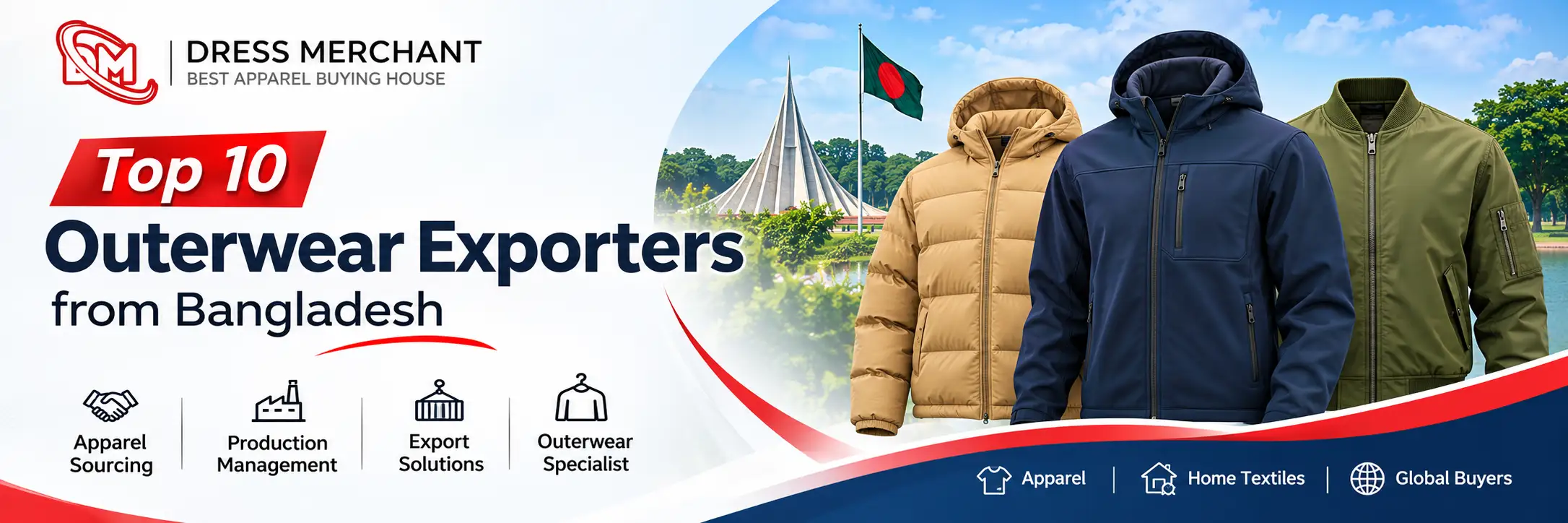
Top 10 Outerwear Exporters from Bangladesh—discover trusted manufacturers and sourcing partners delivering quality, innovation, and reliable production. Explore leading companies for technical outerwear, jackets, winter wear, and performance apparel.
Thank you for reading this post, don't forget to subscribe!With Dress Merchant, a leading garments buying house and fashion buying agent, international buyers can access dependable sourcing, production, quality control, and export solutions tailored to global markets.
Top 10 Outerwear Exporters from Bangladesh to Know in 2026
Bangladesh has established itself as one of the world’s most important apparel sourcing destinations, offering international buyers a combination of manufacturing expertise, competitive pricing, large-scale production capacity, and an increasingly strong focus on sustainability. For buyers looking for reliable outerwear suppliers, the country offers a broad network of manufacturers capable of producing jackets, coats, parkas, padded garments, vests, windbreakers, and other seasonal apparel.
The top outerwear exporters from Bangladesh are distinguished not only by production capacity but also by their ability to meet international quality, compliance, delivery, and product-development requirements. For a new buyer, selecting a supplier should therefore involve more than comparing unit prices. Factory capability, product specialization, quality-control systems, certifications, production planning, communication, and export experience should all be considered.
Bangladesh’s wider apparel industry has a substantial international footprint. BGMEA data shows that the country’s apparel exports reached approximately US$38.70 billion in FY2025-26, covering both woven and knit products. This extensive export ecosystem gives international buyers access to experienced manufacturers and supporting supply-chain partners.
When evaluating the top 10 outerwear exporters from Bangladesh, buyers should look for companies with proven experience in export-oriented production, consistent quality, transparent communication, responsible manufacturing practices, and the ability to develop products according to specific brand requirements.
For international brands, wholesalers, retailers, private-label companies, and fashion businesses, working with the right Bangladeshi outerwear supplier can create a reliable long-term sourcing relationship rather than simply a one-time production arrangement.
Why Bangladesh Is a Leading Hub for Outerwear Manufacturing and Export
Bangladesh has become a major global apparel sourcing hub because of its extensive manufacturing infrastructure, skilled workforce, established export ecosystem, and experience serving international fashion markets.
The country’s garment industry produces a wide variety of woven and knit products for buyers across Europe, North America, Asia, and other international markets. This diversity is particularly valuable for outerwear buyers because many manufacturers already have experience with complex construction, multiple fabric types, finishing processes, trims, and quality-control requirements.
Outerwear production often requires specialized knowledge. A jacket may involve multiple layers, lining, padding, zippers, snaps, tapes, drawcords, labels, pockets, reinforcement, waterproof or water-resistant finishes, and detailed stitching. Experienced outerwear manufacturers in Bangladesh can coordinate these requirements through established production and sourcing networks.
Another advantage is Bangladesh’s integrated apparel supply chain. Depending on the supplier and product category, buyers can access fabric sourcing, dyeing, washing, printing, embroidery, trims, accessories, cutting, sewing, finishing, inspection, and export services within the country’s broader manufacturing ecosystem. BGMEA describes Bangladesh’s apparel sector as having broad supply-chain capabilities across areas such as washing, dyeing, finishing, embroidery, and printing.
For new international buyers, this ecosystem can simplify sourcing. Instead of managing every stage independently, a capable exporter or sourcing partner can coordinate multiple production requirements and provide a more streamlined route from product development to shipment.
Bangladesh is also increasingly focused on sustainability and responsible manufacturing. Industry initiatives now emphasize environmental compliance, ESG reporting, traceability, resource efficiency, and sustainable production.
These developments make Bangladesh an increasingly attractive option for brands looking for competitive manufacturing combined with stronger responsible-sourcing capabilities.
What Types of Outerwear Do Bangladeshi Exporters Manufacture?
The outerwear manufacturing sector in Bangladesh covers a wide range of products designed for different seasons, markets, consumer groups, and price segments.
International buyers can source lightweight fashion outerwear as well as heavier winter garments from experienced suppliers. Depending on factory capabilities, product development may include:
- Puffer jackets
- Quilted jackets
- Winter jackets
- Down-style jackets
- Parkas
- Windbreakers
- Bomber jackets
- Field jackets
- Utility jackets
- Softshell jackets
- Rain jackets
- Lightweight jackets
- Padded vests
- Fleece jackets
- Casual coats
- Fashion coats
- Children’s outerwear
- Workwear and protective outerwear
- Sports and outdoor jackets
The choice of fabric and construction depends heavily on the target market and intended use. Outerwear exporters may work with polyester, recycled polyester, nylon, cotton, cotton blends, fleece, synthetic insulation, technical fabrics, and other materials.
For fashion brands, design flexibility is particularly important. Buyers may require custom silhouettes, branded trims, specific colors, private labels, customized packaging, special washes, or unique finishing techniques. A capable Bangladesh outerwear manufacturer should be able to translate technical specifications and design concepts into commercially viable finished garments.
Product development is also an important part of modern apparel sourcing. International buyers may provide tech packs, reference samples, measurement charts, artwork, material specifications, and testing requirements. The supplier then works through sampling, revisions, costing, approval, bulk production, quality inspection, and shipment.
For new buyers, it is advisable to discuss the complete product range with potential suppliers before placing an order. A manufacturer that is highly experienced in T-shirts, for example, may not necessarily have the specialized capability required for technical jackets or padded outerwear.
Key Strengths of Bangladesh’s Top Outerwear Exporters
The strongest outerwear exporters in Bangladesh typically combine manufacturing expertise with organized production management and international buyer support.
One of the most important strengths is production scalability. Established exporters can often manage different order quantities depending on factory capacity, product type, season, and production schedule. This can be particularly valuable for international brands that need to increase volumes as their business grows.
Another important advantage is product-development experience. Outerwear requires close attention to measurements, construction, fabric behavior, trims, stitching, insulation, and finishing. Experienced manufacturers understand how these elements influence fit, appearance, durability, and production cost.
Cost competitiveness is another reason international buyers consider Bangladesh. The country’s established apparel manufacturing ecosystem enables buyers to access competitive production costs while maintaining export-oriented manufacturing standards.
Supply-chain coordination is equally important. A professional exporter should be able to coordinate materials, accessories, production planning, quality control, packing, documentation, and shipment according to the buyer’s requirements.
For international buyers, communication can be just as important as manufacturing capacity. A reliable supplier should provide clear quotations, realistic lead times, sample updates, production status, quality information, and shipping documentation.
Bangladesh also has extensive experience serving international markets. BGMEA reports that the country’s apparel industry exports to numerous global markets, with major destinations including the European Union and North America.
These capabilities make Bangladesh particularly attractive to brands looking for a long-term apparel sourcing partner rather than simply the lowest-cost garment factory.
Quality Standards and Compliance Among Bangladesh Outerwear Exporters
Quality and compliance should be among the first considerations for any international buyer selecting an outerwear exporter in Bangladesh.
A reliable supplier should have clearly defined quality-control procedures covering raw materials, fabric inspection, cutting, sewing, measurements, finishing, packing, and final inspection. Quality should be monitored throughout production rather than checked only after garments are completed.
For outerwear, quality control can involve additional technical considerations. Buyers may need to verify zipper performance, seam strength, insulation distribution, fabric defects, color consistency, measurements, stitching density, button or snap attachment, labeling, and finishing quality.
Depending on the target market and buyer requirements, products may also need to meet specific testing, chemical, safety, social-compliance, or environmental standards.
Factory compliance is another critical issue. International brands increasingly expect suppliers to demonstrate responsible workplace practices, environmental management, worker safety, and transparent business operations.
Bangladesh’s apparel industry has continued strengthening its compliance infrastructure. BGMEA states that it conducts verification and inspection processes for membership requirements and has been strengthening its compliance and inspection mechanisms.
International buyers should nevertheless conduct their own supplier due diligence. Before placing a significant order, it is sensible to request relevant factory information, certifications, audit reports where applicable, product-testing documentation, production references, and details of quality-control procedures.
The objective should not simply be to find a factory that claims to be compliant. Buyers should find a supplier whose systems can consistently demonstrate compliance and quality throughout the business relationship.
Sustainable and Eco-Friendly Outerwear Manufacturing in Bangladesh
Sustainability has become an increasingly important consideration for international apparel buyers, particularly in the European and other highly regulated markets.
For outerwear, sustainability can involve several areas, including recycled materials, responsible sourcing, water and energy efficiency, waste reduction, chemical management, renewable energy, packaging choices, product durability, and supply-chain traceability.
Bangladesh’s apparel sector is actively developing its sustainability capabilities. BGMEA and international partners are working on initiatives involving energy efficiency, circularity, sustainable industrialization, environmental compliance, and resource management.
Traceability is also becoming increasingly important. In 2026, BGMEA announced cooperation focused on digital product passport readiness and supply-chain traceability, reflecting the growing importance of verifiable product and material information for international markets.
For buyers, sustainability should therefore be evaluated as part of supplier selection rather than treated as a marketing slogan.
A responsible outerwear supplier in Bangladesh should be able to discuss material sourcing, production processes, waste management, energy consumption, factory certifications, social compliance, and any sustainability programs relevant to the buyer’s requirements.
Brands can also request recycled polyester, recycled nylon, organic or preferred fibers, responsible packaging, and other material options where appropriate.
Choosing a supplier with established sustainability practices can help international brands meet their own environmental commitments while building a more transparent and resilient supply chain.
How Bangladeshi Outerwear Exporters Serve Global Fashion Brands
Bangladesh’s leading outerwear exporters work with a wide range of international customers, including fashion brands, retailers, wholesalers, importers, private-label businesses, and sourcing companies.
The relationship generally begins with product development. A buyer may submit a tech pack, design sketch, reference sample, fabric specification, or product brief. The supplier then develops samples and provides costing based on materials, construction, order quantity, and production requirements.
After sample approval, the buyer and supplier normally finalize specifications, pricing, quantities, delivery schedules, packaging, labeling, and quality requirements.
Production then moves through material procurement, cutting, sewing, finishing, inspection, packing, and shipment. Professional exporters maintain communication throughout these stages so buyers can monitor progress and address issues before they affect delivery.
For global brands, flexibility is also important. Fashion businesses may require different styles, seasonal collections, multiple colorways, customized labels, or different packaging requirements. An experienced exporter should have the organizational capacity to manage these variations.
Bangladesh’s extensive export experience provides a strong foundation for this type of international business. The country’s apparel industry serves markets around the world, while current industry initiatives continue to focus on market diversification and expanding Bangladesh’s presence in new international markets.
For a new buyer, the best supplier is therefore not necessarily the largest factory. It is the supplier that best matches the buyer’s product requirements, order volume, quality expectations, compliance needs, communication standards, and delivery schedule.
Outerwear Sourcing and Production Capabilities in Bangladesh
Successful outerwear sourcing involves much more than identifying a factory with sewing capacity. Buyers should evaluate the entire production process from material sourcing to final shipment.
A professional outerwear sourcing company in Bangladesh can help international buyers identify appropriate manufacturers, compare production capabilities, develop products, negotiate pricing, coordinate samples, monitor quality, and manage communication with factories.
The sourcing process may begin with supplier identification. Based on the product category, target price, quantity, quality requirements, and delivery destination, a sourcing partner can shortlist suitable manufacturers.
The next stage is product development and costing. Buyers can provide technical specifications and receive quotations based on fabric, trims, construction, order quantity, and other production requirements.
Sampling then allows the buyer to evaluate the product before bulk production. Fit samples, size sets, pre-production samples, and other approval stages may be required depending on the product and buyer’s internal procedures.
During bulk production, quality control becomes particularly important. Inspections can be performed at different stages to identify defects early and reduce the risk of costly problems at the end of production.
Finally, finished garments must be packed and prepared for export according to the buyer’s shipping instructions.
This end-to-end approach can be particularly valuable for new international buyers who may not yet have established relationships with Bangladeshi manufacturers.
How to Choose the Right Outerwear Exporter in Bangladesh
Choosing the right outerwear exporter in Bangladesh requires careful supplier evaluation. Price is important, but it should never be the only selection criterion.
Start by reviewing the supplier’s product expertise. If you need padded jackets, technical outerwear, rainwear, or fashion coats, confirm that the manufacturer has relevant experience rather than assuming that all apparel factories can produce every type of outerwear.
Next, evaluate production capacity and order flexibility. Ask about minimum order quantities, monthly capacity, seasonal capacity, lead times, and the supplier’s ability to handle repeat orders.
Quality management should also be examined carefully. Request information about fabric inspection, inline inspection, final inspection, testing procedures, and defect-management systems.
Compliance is equally important. Ask for relevant certifications, audit documentation, factory information, and evidence of social and environmental responsibility.
Communication should also be tested before placing an order. A supplier that responds clearly and professionally during the quotation and sampling stages is more likely to provide a smoother experience during production.
International buyers should also consider:
- Product-development capability
- Fabric and trim sourcing
- Sampling speed
- Production lead time
- Quality-control systems
- Factory compliance
- Sustainability practices
- Export experience
- Packaging and labeling capabilities
- Shipping and documentation support
- Communication and reporting
- Ability to support long-term orders
A supplier should ultimately be evaluated on total value and reliability, not simply the lowest quoted price.
For new buyers entering the Bangladesh market, working with an experienced sourcing partner can also reduce the complexity of identifying and managing suitable manufacturers.
How Dress Merchant Helps Buyers Source Outerwear from Bangladesh
For international buyers looking for a reliable route into Bangladesh’s apparel manufacturing sector, Dress Merchant provides sourcing and buying-house support designed to simplify the procurement process.
As a Bangladesh-based apparel buying house and sourcing partner, Dress Merchant can connect international buyers with suitable manufacturing resources according to their product specifications, quality expectations, order requirements, and target markets.
The sourcing process can include supplier identification, product development, price negotiation, sample coordination, production follow-up, quality control, and export coordination. This gives buyers a single point of communication while reducing the complexity of working with multiple factories independently.
For outerwear projects, supplier selection should be based on the exact product requirement. A buyer looking for lightweight fashion jackets may need a different manufacturing partner from a buyer developing insulated winter coats, technical outerwear, or children’s jackets.
Dress Merchant’s role is therefore not simply to find a garment factory. The objective is to identify the right manufacturing solution for each buyer and help manage the process from initial sourcing through production and shipment.
For international brands, retailers, wholesalers, and private-label businesses, this approach can make Bangladesh sourcing more efficient and transparent.
As the Bangladesh apparel industry continues to strengthen its sustainability, compliance, traceability, and international-market capabilities, buyers have an opportunity to build long-term relationships with capable local sourcing partners.
If your business is looking for outerwear manufacturers, jacket exporters, apparel suppliers, or a reliable garment sourcing partner in Bangladesh, selecting the right supplier is the first step toward creating a dependable international supply chain. With the right sourcing strategy, Bangladesh can offer competitive manufacturing, product flexibility, experienced suppliers, and scalable production for global fashion businesses.
Conclusion: Top 10 Outerwear Exporters from Bangladesh
Choosing the right partner from the Top 10 Outerwear Exporters from Bangladesh can make a significant difference in product quality, production efficiency, compliance, and delivery performance. Bangladesh has developed strong expertise in manufacturing and exporting jackets, coats, padded outerwear, technical garments, workwear, and other winter apparel for international markets. However, international buyers need more than manufacturing capacity—they need reliable sourcing, quality control, competitive pricing, transparent communication, and consistent production support.
As a professional Apparel Buying House, Apparel Buying Agent, and Sourcing Agent for apparel manufacturers and exporters in Bangladesh, Dress Merchant helps international buyers connect with suitable manufacturing partners and manage the sourcing process from development to shipment. Our expertise covers apparel sourcing, production coordination, quality assurance, compliance monitoring, and export support.
Whether you are sourcing technical outerwear, casual jackets, winter clothing, or specialized performance garments, partnering with the right Bangladesh-based sourcing team can simplify the entire process and reduce sourcing risks. Dress Merchant is committed to helping global buyers source quality outerwear and apparel from Bangladesh with confidence, efficiency, and long-term value.