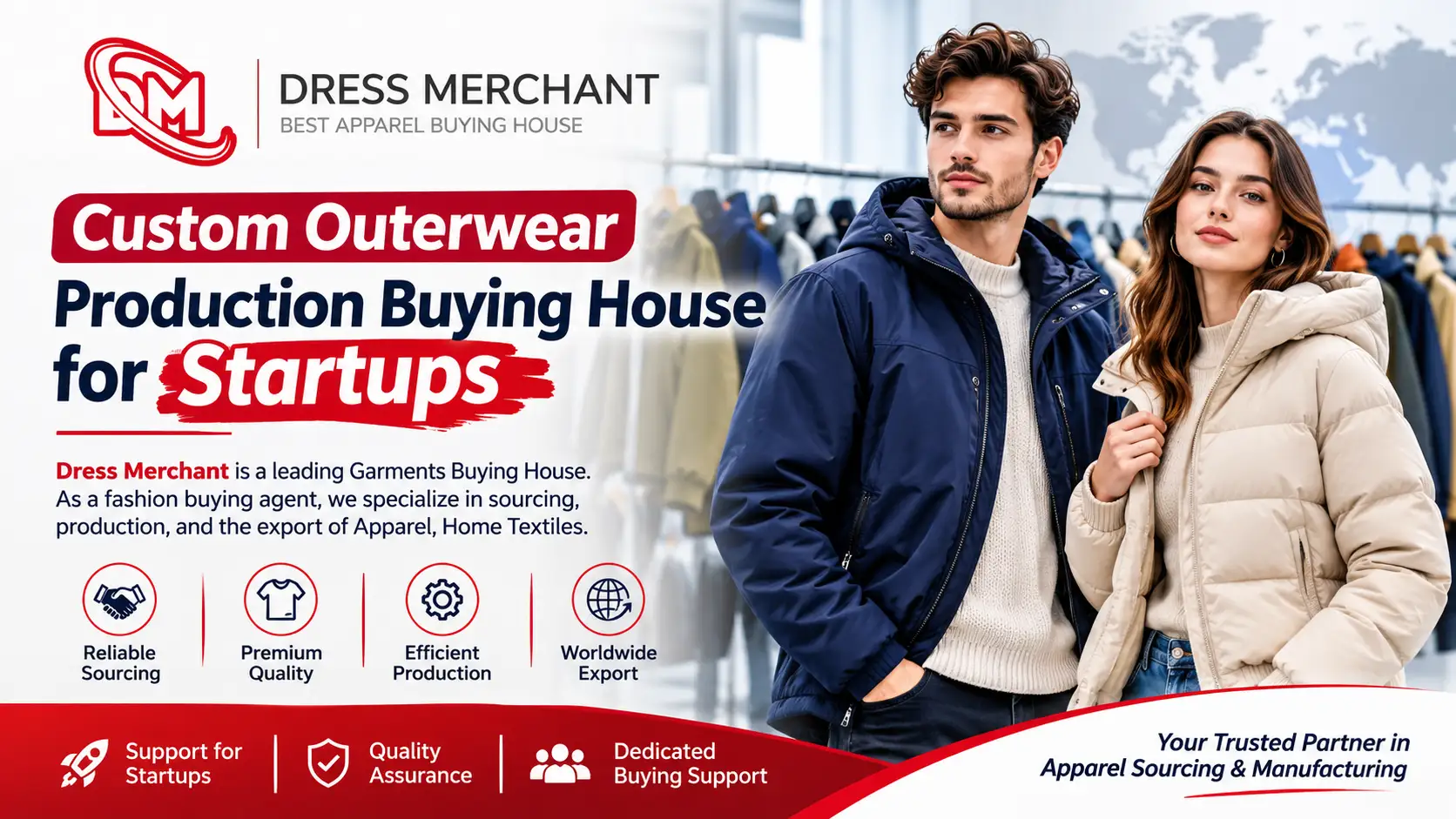
Custom Outerwear Production Buying House for Startups—turn your apparel vision into market-ready products with confidence. Dress Merchant helps emerging brands with custom outerwear sourcing, product development, production management, quality control, and export support.
Thank you for reading this post, don't forget to subscribe!As a trusted garments buying house and fashion buying agent in Bangladesh, we connect startups with reliable manufacturers and deliver flexible, quality-driven solutions built for growth.
Why Startups Need a Reliable Custom Outerwear Production Buying House
Launching an outerwear collection requires more than finding a factory that can manufacture garments. For startups and emerging fashion brands, the right sourcing partner can help turn an initial product concept into a commercially viable collection while reducing production risks. A reliable custom outerwear production buying house acts as a bridge between international buyers and qualified garment manufacturers in Bangladesh.
For a new brand, managing fabric sourcing, factory communication, sampling, costing, production schedules, quality control, and export documentation can be challenging. A professional buying house coordinates these processes and helps buyers work with suitable manufacturing partners based on product requirements, order volume, quality standards, and target price.
Bangladesh is one of the world’s major apparel manufacturing destinations, offering extensive production capabilities and a strong supplier base. By working with an experienced apparel buying agent, international startups can access this manufacturing ecosystem without having to manage every production stage independently.
A dependable buying house also provides greater visibility throughout the order process. From initial product development to final inspection, the sourcing team can monitor production progress, communicate with factories, identify potential issues, and coordinate corrective action when necessary.
For startups entering the fashion market, this support can be particularly valuable. Instead of dealing with multiple suppliers independently, buyers can work through one experienced sourcing partner that understands their product requirements and commercial objectives.
How a Buying House Helps Startups Develop Custom Outerwear Collections
Product development is one of the most important stages for a new fashion brand. A good idea needs to be translated into accurate specifications before manufacturing can begin. A professional buying house helps startups move from concept to production-ready garments through structured product development support.
International buyers may provide sketches, reference garments, technical packs, measurement charts, fabric specifications, or even simple product ideas. The sourcing team can communicate these requirements with suitable manufacturers and help determine the most practical production approach.
Custom outerwear can include jackets, coats, parkas, windbreakers, padded jackets, overshirts, vests, and other seasonal garments. Each product may require different fabrics, construction techniques, trims, insulation, finishing processes, and quality standards.
A buying house can assist with:
- Product specification review
- Manufacturer selection
- Fabric and trim sourcing
- Sample development
- Measurement and fitting coordination
- Costing and price negotiation
- Production planning
- Quality assurance
- Shipment coordination
This development support is especially useful for startups because product specifications often evolve during sampling. Instead of making costly decisions after bulk production begins, buyers can evaluate samples, adjust measurements, review materials, and finalize construction details before approving production.
With the right sourcing partner, startups can therefore approach custom outerwear manufacturing with greater confidence and a more organized development process.
Custom Outerwear Design and Product Development for Emerging Brands
Emerging fashion brands often need products that reflect a distinctive brand identity rather than standard catalog designs. Custom outerwear production allows startups to develop garments around their own design language, target customers, seasonal collections, and market positioning.
A professional apparel sourcing company can help translate creative concepts into practical manufacturing specifications. This may involve reviewing garment construction, fabric weight, color options, stitching details, pocket designs, closures, labels, embellishments, and other components.
For example, a startup launching a premium streetwear label may require heavyweight fabrics, oversized silhouettes, custom hardware, branded labels, and specialized finishing. Another brand focused on outdoor clothing may prioritize water resistance, insulation, functional pockets, durable stitching, and technical fabrics.
The product development process should balance design ambition with manufacturing feasibility and target cost. An experienced buying house can communicate with manufacturers to determine which construction methods and materials are suitable for the intended product.
Sampling is particularly important at this stage. A prototype or development sample allows buyers to assess the actual appearance, fit, fabric behavior, construction, and finishing before bulk production.
For international buyers working remotely, having a local sourcing partner in Bangladesh can make this process considerably easier. The buying house can coordinate communication with factories, follow sample development, and help ensure that the final product remains aligned with the buyer’s approved specifications.
Fabric and Material Sourcing for Custom Outerwear Production
Fabric selection has a major impact on the appearance, performance, durability, comfort, and cost of an outerwear product. Startups therefore need a sourcing partner that understands both the creative and technical aspects of material selection.
Depending on the product category, outerwear may require materials such as polyester, nylon, cotton, cotton blends, twill, fleece, softshell fabrics, recycled materials, coated fabrics, quilted materials, or other performance textiles.
A buying house can help international buyers identify suitable fabrics based on the intended use and target market. Important considerations may include fabric weight, composition, hand feel, color fastness, shrinkage, durability, water resistance, breathability, and finishing requirements.
Outerwear production also involves more than the main fabric. Supporting materials may include lining, padding or insulation, zippers, buttons, snaps, cords, elastic, labels, hang tags, patches, drawstrings, and other garment accessories.
For startups, sourcing these components through an experienced apparel buying agent can simplify supplier coordination and help maintain consistency across the collection.
Material approval should take place before bulk production. Buyers can review fabric swatches, lab dips, trim samples, and other development materials before providing final approval. This structured approach helps reduce the risk of unexpected material differences during mass production.
Low MOQ Outerwear Manufacturing Solutions for Startups
Minimum order quantity is often one of the biggest concerns for new fashion brands. Established retailers may place large production orders, but startups frequently need smaller quantities while they test their products and build customer demand.
Finding manufacturers willing and able to accommodate smaller production requirements can therefore be challenging. A buying house with established factory relationships can help identify manufacturers whose capabilities and commercial terms are better suited to emerging brands.
However, MOQ should not be considered only as a number. The practical minimum order can depend on fabric availability, color combinations, garment construction, trims, production capacity, and factory requirements.
A sourcing partner can help buyers evaluate these factors before confirming an order. Where possible, buyers may also optimize fabric colors, consolidate similar styles, or adjust production planning to make smaller orders more commercially feasible.
For startups, a flexible sourcing strategy can reduce inventory risk. Instead of committing significant capital to an untested product, brands can begin with an appropriate production quantity, evaluate market response, and gradually increase future orders when demand becomes clearer.
The objective is not simply to find the lowest MOQ. It is to find a reliable manufacturing solution that balances order quantity, quality, price, lead time, and production feasibility.
End-to-End Outerwear Production Management for Startup Brands
Managing an international garment order involves numerous stages, and overlooking one detail can affect the final result. An experienced buying house can coordinate these stages and provide a central point of communication between the buyer and manufacturing partners.
The process may begin with product inquiry, technical specification review, and manufacturer selection. After that, the buying house can coordinate costing, material sourcing, sampling, approvals, production planning, and quality inspections.
During bulk production, regular communication is essential. Production progress needs to be monitored against the agreed timeline, while potential issues should be identified early enough to allow corrective action.
A professional sourcing team can also help coordinate pre-production meetings, inline inspections, final inspections, packing requirements, and shipment readiness.
For overseas buyers, this local production management can provide an important advantage. Rather than communicating with multiple factories across different production stages, the buyer has a dedicated sourcing partner who can coordinate activities locally.
At Dress Merchant, our approach as an apparel buying house is focused on connecting international buyers with suitable manufacturing capabilities while supporting the production process from sourcing through shipment. This allows startup brands to focus more on product development, branding, sales, and market growth.
Quality Control Standards for Custom-Made Outerwear
Quality is essential when building a new fashion brand. A poorly manufactured first collection can affect customer satisfaction, product reviews, repeat purchases, and the long-term reputation of a startup.
Quality control for outerwear should begin before bulk production rather than only at the final inspection stage. Product specifications, approved samples, fabrics, trims, measurements, workmanship, and packaging requirements should be clearly established before production begins.
Depending on the product, quality checks may cover:
- Fabric quality and appearance
- Color consistency
- Measurement accuracy
- Stitching and seam quality
- Zipper and fastening performance
- Pocket construction
- Lining and padding
- Label placement
- Print or embroidery quality
- Garment finishing
- Packing specifications
Inline inspections can help identify recurring production problems while manufacturing is underway. A final inspection can then assess completed garments before shipment.
For international buyers, clear quality standards are particularly important because products are often manufactured thousands of kilometers away from the final market. A local buying house can provide additional oversight and help communicate quality expectations directly to manufacturing partners.
Consistent quality control ultimately helps startups build products that meet their approved specifications and support a stronger customer experience.
Custom Outerwear Sampling and Pre-Production Support for Startups
Sampling provides an important opportunity to evaluate a garment before committing to bulk production. For startups, this stage can prevent expensive mistakes by allowing design, fit, fabric, and construction issues to be identified early.
The sampling process may involve several stages, including initial development samples, fitting samples, revised samples, size-set samples, and pre-production samples, depending on the complexity of the product and the buyer’s requirements.
During sample review, buyers can assess measurements, silhouette, fabric behavior, stitching, pocket placement, closures, trims, branding, and overall appearance. Necessary revisions can then be communicated to the manufacturer.
A buying house can coordinate this process between the international buyer and the factory. This is particularly useful when the buyer is working remotely and needs someone locally to follow up with manufacturers.
Once the final sample and specifications are approved, they can serve as important references for bulk production and quality inspection.
For emerging brands, investing adequate attention in sampling can make the bulk production stage more predictable and help ensure that the finished outerwear reflects the original design concept.
Cost-Effective Custom Outerwear Sourcing and Manufacturing in Bangladesh
Cost competitiveness is one of the reasons international brands consider Bangladesh for apparel sourcing. However, achieving the right price should not mean sacrificing product quality, compliance, or production reliability.
A professional buying house helps buyers evaluate the total production cost rather than focusing only on the factory price. Fabric selection, garment construction, trims, order quantity, packaging, quality requirements, shipping considerations, and production efficiency can all influence the final cost.
Experienced sourcing teams can compare suitable manufacturing options and negotiate with suppliers based on the buyer’s specifications and target price.
For startups, cost planning is particularly important because budgets are often limited. A well-planned product can help control unnecessary expenses while maintaining the quality required for the target market.
Bangladesh also offers a broad manufacturing ecosystem covering different apparel categories and production requirements. This gives sourcing companies opportunities to match products with manufacturers based on their capabilities rather than using the same factory for every order.
The goal should be to achieve a practical balance between price, quality, MOQ, lead time, compliance, and production capability. This approach creates a stronger foundation for sustainable international sourcing.
How to Choose the Right Outerwear Buying House for Your Startup Brand
Choosing a buying house is an important decision for any new international apparel buyer. The right partner should provide more than supplier contacts. It should offer reliable communication, production knowledge, quality oversight, and practical sourcing support.
Before selecting a buying house in Bangladesh, international buyers should consider several factors.
First, evaluate the company’s experience with the type of products you want to manufacture. A supplier network that understands jackets, coats, padded garments, outdoor apparel, or other outerwear categories may be better suited to your requirements.
Second, ask about the company’s manufacturing network and production capabilities. A reliable buying house should be able to identify appropriate factories based on product specifications, order volume, quality expectations, and target market.
Third, understand how the company manages quality control and production follow-up. Clear processes for sample approval, production monitoring, inspections, and shipment coordination are important indicators of professional sourcing management.
Communication is equally important. International buyers should work with a partner that responds clearly, provides regular updates, and communicates potential production issues rather than allowing problems to remain hidden until the end of an order.
For startups, flexibility is another valuable consideration. Your first collection may require more development support, smaller quantities, and greater attention to product details than a large established retailer.
As a Bangladesh-based apparel buying house and sourcing partner, Dress Merchant works with international buyers seeking apparel sourcing, production, quality management, and export support. Our objective is to help emerging brands access Bangladesh’s garment manufacturing capabilities through an organized and buyer-focused sourcing process.
Whether you are developing your first outerwear collection or expanding an existing apparel brand, selecting the right sourcing partner can make the journey from concept to finished product significantly more efficient.
Conclusion: Custom Outerwear Production Buying House for Startups
Choosing the right Custom Outerwear Production Buying House for Startups can make a significant difference in turning an apparel idea into a successful product line. Startups need more than just a garment supplier—they need a reliable partner who understands product development, fabric sourcing, customization, quality control, production management, and international export requirements.
Dress Merchant works as a trusted apparel buying house and sourcing agent for apparel manufacturers and exporters in Bangladesh, helping startups and international brands manage the complete outerwear production process. From sourcing suitable fabrics and trims to coordinating sampling, manufacturing, quality inspection, and shipment, our team helps simplify the entire supply chain while maintaining a strong focus on quality, consistency, and timely delivery.
For startups, flexibility and cost efficiency are especially important. Through our network of experienced and compliant manufacturing partners, Dress Merchant can support customized outerwear production based on a buyer’s design, specifications, target market, and order requirements. Our sourcing and production expertise allows emerging brands to develop high-quality outerwear without the complexity of managing multiple suppliers independently.
If you are a startup looking for a dependable custom outerwear sourcing and production partner in Bangladesh, Dress Merchant can help transform your concepts into market-ready garments. With professional sourcing, manufacturing coordination, quality assurance, and export support, we aim to build long-term partnerships with brands that value quality, transparency, and sustainable growth.