
Discover the Best Garments Buying House Company In Bangladesh with Dress Merchant, your trusted fashion buying agent for quality apparel and home textiles. We specialize in reliable sourcing, product development, production management, quality control, and export solutions.
Thank you for reading this post, don't forget to subscribe!Partner with Dress Merchant for competitive pricing, on-time delivery, ethical sourcing, and global-standard garments tailored to your brand’s needs.
1. Why Bangladesh Is a Leading Destination for Garment Sourcing
Bangladesh has established itself as one of the world’s most important destinations for apparel sourcing and garment manufacturing. The country has a large and experienced workforce, a well-developed textile and apparel supply chain, competitive production costs, and a strong export-oriented manufacturing infrastructure. These advantages have made Bangladesh an attractive sourcing destination for international brands, retailers, wholesalers, and fashion companies looking for reliable apparel suppliers.
One of the major strengths of Bangladesh is its extensive garment manufacturing ecosystem. Buyers can source a wide range of products, including T-shirts, polo shirts, sweaters, hoodies, trousers, denim products, jackets, dresses, tops, children’s wear, workwear, activewear, and other fashion garments. The country also has supporting industries for fabrics, trims, labels, packaging, washing, printing, embroidery, and other garment accessories.
A professional garments buying house plays an important role in connecting international buyers with suitable manufacturers in Bangladesh. Instead of dealing with multiple factories independently, buyers can work with an experienced buying agent that manages sourcing, factory selection, product development, sampling, production follow-up, quality control, documentation, and shipment coordination.
Bangladesh is also increasingly recognized for its progress in sustainable and responsible manufacturing. Many factories have invested in energy efficiency, environmentally responsible production, worker safety, social compliance, and internationally recognized certifications.
For global buyers, working with a reliable Bangladesh garments buying house can simplify the sourcing process while improving communication, quality management, cost control, and production efficiency. With its strong manufacturing base and growing capabilities, Bangladesh continues to be an important partner for international apparel sourcing.
2. What Makes a Garments Buying House Company the Best in Bangladesh?
Choosing the best garments buying house company in Bangladesh requires more than simply comparing prices. A professional buying house should provide a complete sourcing solution that combines supplier expertise, product knowledge, quality management, communication, compliance, and reliable delivery. International buyers need a partner capable of understanding their requirements and converting those requirements into commercially successful products.
One of the most important characteristics of a reputable buying house is its factory network. An experienced apparel buying agent should maintain relationships with reliable and compliant manufacturers capable of producing different categories of garments. This allows buyers to select factories according to product type, order quantity, quality requirements, target price, production capacity, and delivery schedule.
Strong communication is another important factor. International buyers often have detailed requirements regarding fabrics, measurements, colors, trims, packaging, labeling, workmanship, and testing. A professional buying house should understand these specifications clearly and communicate them accurately to suppliers.
Quality assurance is equally important. The buying house should establish appropriate quality checkpoints from product development and sample approval through bulk production and final inspection. Proper production follow-up can help identify potential problems before they affect delivery.
Compliance and ethical sourcing are also increasingly important for global brands. Buyers often require factories to meet specific standards relating to labor practices, workplace safety, environmental responsibility, and social compliance.
Finally, a strong buying house should provide dependable after-sales support and transparent communication. From the first inquiry to final shipment, buyers should have a dedicated partner who understands their priorities. These combined capabilities help distinguish a professional garments buying house from a simple intermediary.
3. Comprehensive Apparel Sourcing Services for Global Buyers
A professional apparel buying house provides much more than factory introductions. It acts as a sourcing partner that can manage multiple stages of the garment production process on behalf of international buyers. Comprehensive sourcing services can make the entire procurement process more organized, efficient, and manageable.
The process generally begins with understanding the buyer’s product requirements. These may include garment designs, technical specifications, fabric composition, measurements, color standards, packaging instructions, quantity, target price, and delivery requirements. Based on these details, the buying house identifies appropriate manufacturers from its supplier network.
Product development is another important service. Buying houses can coordinate fabric sourcing, trims, accessories, pattern development, samples, printing, embroidery, washing, and other requirements. Samples are then developed and submitted for buyer approval before bulk production begins.
Price negotiation is also an important part of sourcing. An experienced buying agent can communicate with suitable factories and negotiate commercially competitive prices based on product specifications, order quantities, materials, and production requirements.
Production monitoring helps ensure that approved specifications are followed throughout manufacturing. The buying house can maintain regular communication with factories, monitor production progress, identify potential delays, and coordinate corrective actions where necessary.
Quality control is integrated into the sourcing process through inspections and production follow-up. Depending on buyer requirements, inspections may be performed during different production stages and before shipment.
The buying house can also coordinate packaging, documentation, shipment preparation, and export-related processes. This provides international buyers with a centralized sourcing partner rather than requiring them to manage multiple suppliers independently.
For brands and retailers seeking efficient apparel sourcing from Bangladesh, comprehensive buying house services can significantly simplify the supply chain while providing better visibility and coordination.
4. Quality Control and Production Management in Garment Manufacturing
Quality control is one of the most important responsibilities of a professional garments buying house. International buyers expect products to meet approved specifications consistently, and even small quality issues can affect customer satisfaction, brand reputation, and delivery schedules. Therefore, systematic quality management should be integrated throughout the garment manufacturing process.
Quality control begins during product development. Before bulk production, the buying house can review fabric quality, measurements, construction details, trims, colors, prints, embroidery, labeling, and other specifications. Sample approval provides a reference standard that the factory must follow during bulk manufacturing.
During production, regular follow-up helps identify potential problems at an early stage. A professional buying house can communicate with factory production teams and monitor whether the manufacturing process is progressing according to the agreed schedule. If deviations are identified, corrective measures can be discussed before the issue becomes more serious.
Garment inspections can cover different aspects of manufacturing, including stitching quality, measurements, fabric defects, shade variation, workmanship, appearance, labeling, packaging, and overall product conformity. The specific inspection process can be adapted according to the buyer’s quality standards.
Production management is also closely connected with delivery performance. Delays can occur because of fabric availability, production capacity, approval changes, quality problems, or other supply chain issues. Continuous communication between the buying house, factory, and buyer can help minimize these risks.
A reliable garments buying house therefore functions as an important quality and production management partner. By coordinating factories, monitoring progress, checking quality, and communicating with buyers, the buying house helps create a more controlled and transparent manufacturing process from sample development through final shipment.
5. Ethical, Compliant, and Sustainable Garment Sourcing in Bangladesh
Sustainability and ethical manufacturing have become increasingly important in the global apparel industry. International fashion brands and retailers are paying greater attention to environmental responsibility, worker welfare, workplace safety, responsible sourcing, and supply chain transparency. As a result, a modern garments buying house must consider more than price and production capacity when selecting manufacturing partners.
Responsible sourcing begins with identifying appropriate factories. Depending on buyer requirements, manufacturers may need to demonstrate compliance with specific social, environmental, safety, and quality standards. A professional buying house can help buyers identify suppliers that are appropriate for their sourcing requirements.
Sustainable production can involve many different practices. These may include efficient use of energy and water, responsible waste management, environmentally conscious materials, reduced resource consumption, and improved production processes. The exact sustainability requirements vary between buyers and product categories.
Worker welfare is another important consideration. Responsible garment manufacturing requires appropriate working conditions, workplace safety measures, fair treatment, and compliance with applicable labor requirements. Buying houses can communicate buyer expectations to factories and include relevant compliance considerations during supplier selection and production monitoring.
Sustainability can also extend to garment accessories and packaging. Buyers may request recycled materials, sustainable fabrics, responsible labels, environmentally conscious packaging, or other lower-impact alternatives.
For international brands sourcing from Bangladesh, an experienced buying house can help navigate these requirements by coordinating between buyers and manufacturers. This can make responsible sourcing more practical and transparent.
By incorporating ethical, compliant, and sustainable considerations into the sourcing process, Bangladesh’s apparel supply chain can continue developing as a responsible manufacturing partner for global fashion markets.
6. Wide Range of Apparel Products and Fashion Categories
One of the key advantages of working with an experienced garments buying house in Bangladesh is access to a broad range of apparel products and manufacturing capabilities. International buyers often require different products for multiple markets, seasons, customer segments, and fashion collections. A buying house with a diversified supplier network can help meet these requirements efficiently.
Bangladesh has strong manufacturing capabilities across numerous apparel categories. These include men’s wear, women’s wear, children’s clothing, knitwear, woven garments, casualwear, sportswear, workwear, outerwear, denim, sweaters, and fashion basics. Common products include T-shirts, polo shirts, shirts, tops, dresses, trousers, jeans, hoodies, sweatshirts, jackets, shorts, leggings, and other garments.
A professional buying house can help buyers identify suitable factories according to product specialization. For example, a manufacturer experienced in knitwear may be selected for T-shirts and sweatshirts, while a specialized woven factory may be considered for shirts, dresses, or trousers.
Product development is also important in modern fashion sourcing. Buyers may provide sketches, reference samples, technical packs, or concepts that need to be transformed into production-ready garments. The buying house can coordinate fabric selection, trims, accessories, sampling, pattern development, printing, embroidery, washing, and finishing.
In addition to apparel, some buying houses also support sourcing for home textiles, handicrafts, leather goods, and related products, depending on their supplier network and capabilities.
This broad sourcing capability allows international buyers to consolidate different requirements through one professional sourcing partner. Instead of searching independently for manufacturers for every product category, buyers can benefit from a coordinated sourcing network that understands their quality, pricing, compliance, and delivery expectations.
7. Reliable Garment Factory Network and Supplier Management
A strong factory network is one of the most valuable assets of a professional garments buying house. International buyers need manufacturers that can consistently meet their requirements for quality, capacity, pricing, compliance, and delivery. Finding the right factory for every product can be difficult without local industry knowledge, which is where an experienced buying house provides significant value.
Bangladesh has a large number of garment manufacturers with different areas of specialization. Some factories focus on knitwear, while others specialize in woven garments, denim, sweaters, outerwear, children’s clothing, sportswear, or other product categories. Production capacities also vary significantly between factories.
A professional buying house can evaluate suppliers based on the specific needs of each order. Important considerations may include factory capabilities, machinery, production capacity, product expertise, quality systems, compliance requirements, previous experience, and delivery performance.
Supplier management does not end after factory selection. The buying house can maintain regular communication with manufacturers throughout product development and bulk production. This helps ensure that factory teams understand approved specifications, buyer requirements, quality standards, and delivery schedules.
Managing multiple suppliers also requires effective coordination. Fabric suppliers, accessory manufacturers, garment factories, testing laboratories, inspection teams, logistics providers, and buyers may all be involved in a single order. A buying house can help coordinate these parties and keep the production process organized.
For international buyers, a reliable supplier network can reduce the time and effort required to source garments from Bangladesh. It can also provide access to specialized manufacturing capabilities that may not be easy to identify independently.
Effective supplier management ultimately creates a more structured sourcing environment and helps buyers establish long-term relationships with suitable manufacturing partners.
8. Competitive Pricing and Cost-Effective Apparel Sourcing Solutions
Cost management is a major consideration for fashion brands, retailers, wholesalers, and importers sourcing garments internationally. However, competitive pricing should not be considered separately from quality, production capability, compliance, and delivery performance. A professional garments buying house helps buyers evaluate the complete value of a sourcing opportunity rather than focusing only on the lowest initial quotation.
Bangladesh is widely recognized as a competitive apparel manufacturing destination because of its established supply chain, experienced workforce, manufacturing infrastructure, and large production base. These factors can create opportunities for cost-effective garment sourcing across different product categories.
A buying house can support cost management from the early stages of product development. Fabric selection, garment construction, trims, accessories, packaging, order quantities, and production methods can all influence the final product cost. By discussing these factors with factories, the buying house can help buyers explore practical alternatives that meet their specifications.
Supplier selection also affects pricing. Different factories may have different production capabilities, capacities, efficiency levels, and cost structures. An experienced sourcing partner can compare suitable manufacturing options based on the buyer’s requirements.
Transparent communication is important when managing garment costs. Buyers should understand what is included in a quotation and which specifications influence price changes. Any changes in fabric, design, quantity, packaging, or delivery requirements can affect the final cost and should be communicated clearly.
Cost-effectiveness should therefore be viewed as a combination of appropriate pricing, consistent quality, efficient production, reduced sourcing risks, and dependable delivery. A professional Bangladesh garments buying house can help international buyers achieve a balanced sourcing solution that aligns commercial requirements with product expectations.
9. Seamless Export, Logistics, and International Buyer Support
The garment sourcing process does not end when production is completed. Export documentation, packaging, inspection, shipment coordination, and communication are also important parts of international apparel procurement. A professional garments buying house can help coordinate these activities so that buyers experience a smoother transition from production to delivery.
Before shipment, finished garments normally need to meet approved quality and packaging requirements. The buying house can coordinate final inspections and communicate any necessary corrective actions to the factory. Packaging details such as carton markings, labels, folding methods, assortment requirements, and packing specifications may also need to follow buyer instructions.
Documentation is another important aspect of international trade. Depending on the transaction and destination, different commercial and shipping documents may be required. A buying house can coordinate with relevant suppliers, factories, and logistics partners to ensure that required information is properly prepared and communicated.
Shipment planning also requires coordination. Production completion dates need to align with booking schedules and shipping arrangements. If there are production delays, the buying house can communicate with the buyer and relevant partners so that alternative arrangements can be considered when necessary.
International buyer support is equally important throughout the process. Buyers may need updates regarding sample approvals, production status, quality inspections, shipment schedules, or documentation. Timely communication allows buyers to make informed decisions and manage their own inventory and sales planning.
For overseas customers, having a local sourcing partner can provide valuable operational support. Instead of managing communication with multiple factories and suppliers from another country, buyers can work through an experienced Bangladesh garments buying house that coordinates the different stages of the supply chain.
This integrated approach can make apparel sourcing more organized, transparent, and convenient for international buyers.
10. Why Choose Dress Merchant as a Garments Buying House Company in Bangladesh
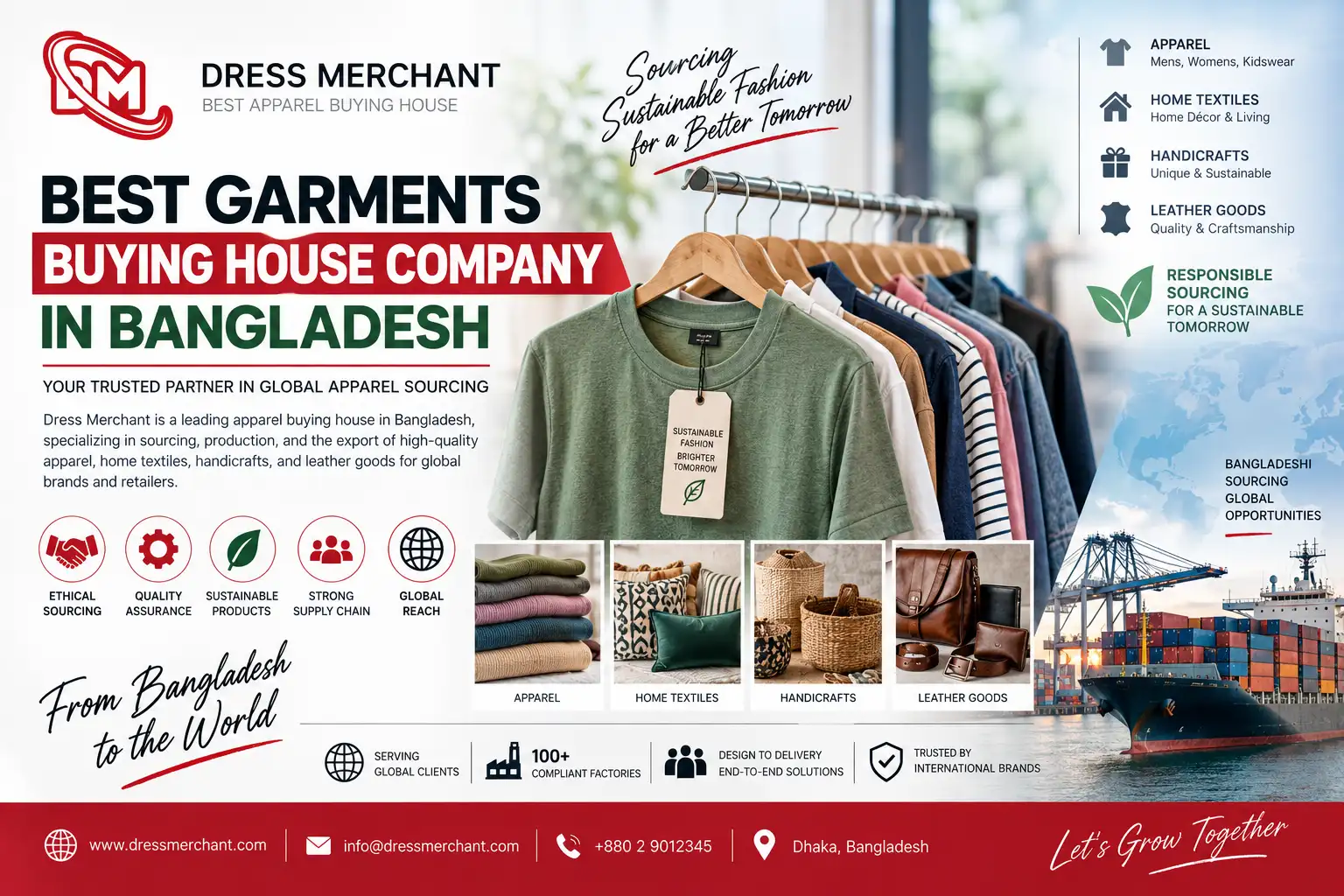
Dress Merchant is a Bangladesh-based apparel buying house and sourcing partner serving the requirements of international buyers. The company focuses on apparel sourcing, product development, production coordination, and export-related support, helping customers connect with suitable manufacturing resources in Bangladesh.
As a garments buying house, Dress Merchant can support buyers through different stages of the sourcing process. This includes understanding product requirements, identifying suitable suppliers, coordinating samples, communicating specifications, monitoring production, supporting quality control, and coordinating shipment-related activities.
The company works with a network of manufacturing partners to support different apparel requirements. Depending on the buyer’s product specifications, sourcing needs, quantity, quality expectations, and delivery requirements, suitable manufacturing options can be identified and coordinated.
Dress Merchant also focuses on providing a structured sourcing experience for international customers. Clear communication is particularly important when dealing with overseas buyers because product specifications, approvals, production updates, and shipment requirements must be communicated accurately throughout the order lifecycle.
In addition to apparel, the company’s sourcing capabilities can extend to areas such as home textiles, handicrafts, and leather goods, allowing buyers to explore multiple product categories through a single Bangladesh-based sourcing partner.
For buyers searching for a Best Garments Buying House Company in Bangladesh, it is important to evaluate factors such as sourcing expertise, supplier relationships, quality management, communication, compliance awareness, product capabilities, and export support. Dress Merchant positions its services around these key aspects of international apparel sourcing.
By combining local market knowledge with supplier coordination and buyer-focused support, Dress Merchant aims to make garment sourcing from Bangladesh more efficient and manageable for international brands, retailers, wholesalers, and fashion businesses.
Conclusion: Best Garments Buying House Company In Bangladesh
Bangladesh stands out as a vibrant hub for exquisite handicrafts, offering a wide range of products that reflect the country’s rich cultural heritage, skilled craftsmanship, and innovative designs. From intricate jute and bamboo crafts to handwoven textiles, pottery, metalwork, and traditional decorative items, the scope of handicraft exports is vast and highly sought after in international markets.
As a trusted handicraft sourcing and export partner, Dress Merchant connects global buyers with reliable manufacturers and exporters across Bangladesh. We ensure that each product meets international quality standards while preserving the authenticity and uniqueness of Bangladeshi craftsmanship. By choosing Dress Merchant as your sourcing agent, businesses can access a diverse range of premium handicrafts, benefit from seamless supply chain management, and confidently expand their offerings in global markets.
With Bangladesh’s growing reputation for high-quality, culturally rich handicrafts, partnering with Dress Merchant ensures a smooth, professional, and profitable journey from sourcing to export.