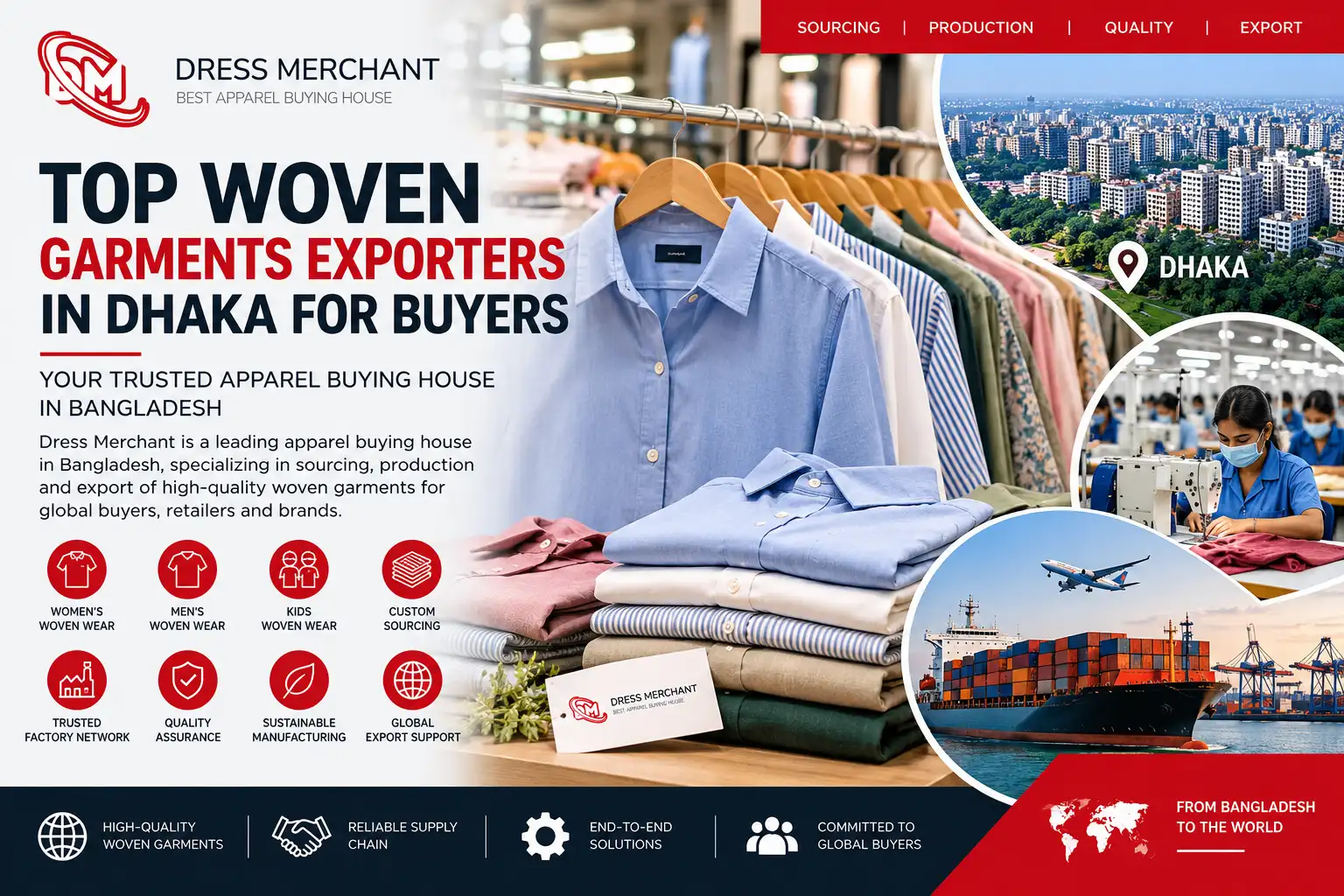
Top Woven Garments Exporters In Dhaka For Buyers—connect with Dress Merchant, a leading garments buying house and trusted fashion buying agent in Bangladesh. We specialize in reliable sourcing, quality production, and seamless export of woven apparel and home textiles.
Thank you for reading this post, don't forget to subscribe!From product development and supplier selection to quality control and shipment, Dress Merchant delivers efficient, buyer-focused solutions tailored to global fashion brands and retailers.
1. Why Choose Top Woven Garments Exporters in Dhaka for Global Sourcing?
Dhaka has become an important sourcing destination for international fashion brands, retailers, wholesalers, and importers looking for dependable woven garment suppliers. Choosing top woven garments exporters in Dhaka can give buyers access to experienced manufacturers, skilled workers, competitive production costs, and a wide range of apparel products. The city has developed a strong garment ecosystem that connects fabric suppliers, manufacturers, accessories producers, buying houses, logistics providers, and exporters.
For international buyers, working with an experienced woven garment exporter can simplify the entire sourcing process. Instead of coordinating with multiple suppliers independently, buyers can work with a professional sourcing partner that manages product development, fabric selection, sampling, production follow-up, quality inspection, compliance, packaging, and shipment coordination. This integrated approach can save time and reduce communication difficulties during international orders.
Dhaka’s woven apparel sector produces a diverse range of products, including shirts, blouses, trousers, dresses, skirts, jackets, uniforms, workwear, casualwear, and other fashion garments. Exporters can also support customized designs according to a buyer’s technical specifications, measurements, fabric requirements, color standards, labeling instructions, and packaging preferences.
Another important advantage is the availability of experienced garment professionals. From merchandising and product development to quality control and production management, Bangladesh’s apparel industry has developed extensive expertise in serving international markets.
For buyers, however, selecting an exporter should involve careful evaluation. Factors such as production capabilities, quality management, factory compliance, communication, lead time, product specialization, and export experience should be considered before placing an order.
A professional company such as Dress Merchant can help international buyers navigate Bangladesh’s apparel sourcing environment by coordinating sourcing, production, quality control, and export-related requirements. This makes Dhaka an attractive destination for buyers seeking reliable woven garment sourcing solutions.
2. What Makes Dhaka a Leading Hub for Woven Garment Manufacturing and Export?
Dhaka is one of the major centers of Bangladesh’s apparel industry and plays an important role in woven garment manufacturing and export. Over the years, the city and surrounding industrial areas have developed an extensive supply chain supporting international apparel production. This ecosystem helps manufacturers and exporters serve fashion brands, retailers, wholesalers, and private-label businesses across different global markets.
One of the key strengths of Dhaka is its concentration of experienced apparel professionals and manufacturing facilities. Buyers can find companies specializing in product development, merchandising, fabric sourcing, garment manufacturing, quality assurance, accessories, packaging, and export coordination. This interconnected supply chain makes it easier to manage complex apparel orders from initial concept through final shipment.
The availability of skilled workers is another important factor. Woven garments often require detailed operations such as cutting, sewing, finishing, pressing, embroidery, washing, and quality inspection. Experienced production teams can handle different garment constructions and buyer specifications while maintaining consistent manufacturing processes.
Dhaka also offers access to a broad range of fabrics and garment accessories. Depending on the product requirements, buyers can source cotton, polyester, viscose, linen blends, denim, twill, poplin, and other woven fabrics. Accessories such as buttons, labels, hang tags, drawstrings, tapes, zippers, and packaging materials can also be sourced through Bangladesh’s established supply network.
For international buyers, the combination of manufacturing expertise, sourcing infrastructure, product variety, and export experience makes Dhaka an important apparel sourcing location.
However, buyers should distinguish between manufacturers and professional sourcing partners. A capable buying house or sourcing agent can identify suitable factories according to product requirements, target price, quality expectations, order quantity, and compliance needs.
With experienced sourcing support, buyers can take advantage of Dhaka’s garment manufacturing ecosystem while maintaining greater control over product quality, communication, production, and delivery.
3. Top Woven Garment Products Available for International Buyers
International buyers can source a wide variety of woven apparel products from manufacturers and exporters in Dhaka. The diversity of Bangladesh’s garment manufacturing sector allows suppliers to produce both basic commercial garments and more specialized fashion products according to individual buyer requirements.
Popular woven products include woven shirts, formal shirts, casual shirts, blouses, dresses, skirts, trousers, shorts, jackets, uniforms, workwear, outerwear, and fashion garments. Buyers can also request customized collections based on seasonal trends, target markets, fabric preferences, and specific brand guidelines.
Woven shirts are particularly versatile and can be developed in numerous styles. Buyers may choose cotton poplin, oxford, twill, linen blends, viscose, polyester, or other fabrics depending on the desired appearance and performance. Details such as collars, cuffs, pockets, buttons, plackets, embroidery, prints, and trims can be customized.
Woven trousers and shorts are also widely manufactured for international markets. Manufacturers can develop different fits and constructions, including casual, formal, cargo, utility, and fashion styles. Dresses and skirts can similarly be produced in different silhouettes, fabrics, prints, and finishing techniques.
For brands operating in the workwear and corporate clothing sector, Bangladesh’s woven garment manufacturers can also produce uniforms and functional apparel. These products may require specific fabrics, reinforced stitching, branding, reflective elements, or customized packaging.
International buyers can generally provide tech packs, sketches, samples, measurement charts, fabric specifications, artwork, and other technical information to guide product development. Experienced exporters and sourcing companies can then coordinate with appropriate manufacturing partners.
A professional sourcing company can also help buyers develop products from an initial concept. This may include fabric selection, sample development, costing, supplier coordination, quality control, and production follow-up.
For this reason, buyers searching for woven garments exporters in Dhaka can access a broad product portfolio while benefiting from customized manufacturing and sourcing support.
4. How Woven Garments Exporters in Dhaka Ensure Premium Product Quality
Quality is one of the most important considerations for international apparel buyers. A garment may have an attractive design, but inconsistent measurements, poor stitching, incorrect fabrics, or finishing defects can negatively affect a buyer’s business. For this reason, established woven garments exporters in Dhaka generally place significant emphasis on quality management throughout the production process.
Quality control should begin before bulk production. During the development stage, buyers and sourcing teams review fabric quality, garment construction, measurements, trims, colors, artwork, and finishing details. Samples are then evaluated against the buyer’s technical requirements before production approval.
Fabric inspection is another important stage. Fabrics may be checked for shade consistency, defects, weight, width, shrinkage, colorfastness, and other relevant specifications. Identifying fabric problems early can help reduce production risks.
During manufacturing, quality teams can conduct inline inspections to identify issues while garments are being produced. Stitching quality, seam construction, measurements, appearance, workmanship, and garment components may be checked according to established inspection procedures.
Final inspection is performed after garments have been completed. Depending on buyer requirements, inspection may cover measurements, workmanship, labeling, packaging, appearance, quantity, and other specifications. Some buyers also apply internationally recognized statistical inspection systems such as AQL-based procedures.
Communication is equally important to quality management. Professional sourcing teams maintain communication between buyers, merchandisers, production teams, and quality-control personnel. Clear communication helps ensure that technical requirements are understood before production begins.
For international buyers, choosing a sourcing partner with structured quality-control processes can reduce manufacturing risks and improve consistency between orders.
Dress Merchant, as an apparel buying house and sourcing partner in Bangladesh, can coordinate with suitable manufacturing facilities according to buyer requirements. Through product development, factory coordination, production follow-up, and quality-control support, a sourcing partner can help international buyers maintain their expected product standards from sampling to shipment.
5. Sustainable and Ethical Woven Garment Manufacturing in Bangladesh
Sustainability has become an increasingly important consideration for international fashion buyers. Brands and retailers are paying greater attention to responsible sourcing, environmental practices, worker welfare, material selection, waste reduction, and supply-chain transparency. As a result, buyers searching for woven garments exporters in Dhaka increasingly consider sustainability and ethical manufacturing alongside price and product quality.
Sustainable woven garment production can involve several areas of manufacturing. One important area is fabric selection. Depending on the buyer’s requirements, manufacturers may work with materials such as organic cotton, recycled fibers, responsibly sourced fabrics, and other materials with specific environmental characteristics.
Waste management is another consideration. Efficient cutting processes can reduce fabric waste, while responsible production planning can help minimize unnecessary material consumption. Manufacturers may also focus on efficient use of water and energy throughout relevant production processes.
Ethical manufacturing involves more than environmental practices. International buyers may also evaluate workplace safety, labor standards, employee welfare, working conditions, and responsible employment practices when selecting manufacturing partners.
For brands selling in international markets, responsible sourcing can also support their own sustainability commitments. Buyers may request factory documentation, certifications, audit reports, traceability information, and other compliance-related documentation depending on their sourcing policies.
A professional buying house can play an important role in this process by helping buyers identify appropriate manufacturing partners and communicate their sustainability and compliance requirements clearly. The sourcing team can coordinate documentation, production requirements, quality expectations, and buyer-specific standards.
Bangladesh’s apparel industry has significant experience serving international customers with different compliance requirements. However, sustainability standards vary from buyer to buyer, so buyers should clearly communicate their expectations before production begins.
For companies looking to develop woven apparel collections with responsible sourcing considerations, working with an experienced Bangladesh apparel sourcing partner can make the process more organized and transparent.
6. Quality Control and Compliance Standards Followed by Dhaka Garment Exporters
Quality control and compliance are fundamental components of international apparel sourcing. Buyers need confidence that their garments will meet agreed specifications, production standards, workplace requirements, and applicable market expectations. Therefore, when evaluating top woven garments exporters in Dhaka, buyers should examine both product quality systems and factory compliance practices.
Quality management generally begins with the buyer’s product specification. Technical packs, measurement charts, fabric requirements, approved samples, color standards, packaging instructions, and labeling details provide a foundation for production. The clearer these requirements are, the easier it becomes for manufacturers to maintain consistency.
During production, quality teams can perform several inspections. Fabric inspection may take place before cutting, while inline inspections can identify sewing and construction problems during manufacturing. Final inspections can verify finished garments before shipment.
Compliance is a broader concept. International buyers may evaluate areas such as workplace safety, labor practices, environmental management, factory conditions, documentation, and other supplier requirements. The exact standards depend on the buyer, destination market, product category, and brand policies.
Some buyers may request recognized social or environmental audits and certifications. Others may have their own supplier codes of conduct and compliance procedures. Therefore, exporters need to understand and accommodate buyer-specific requirements.
A professional buying house can simplify this process by coordinating communication between buyers and manufacturing facilities. The sourcing team can help identify suitable factories, collect relevant information, monitor production progress, and coordinate inspections according to buyer instructions.
For international buyers, compliance should not be treated as a final-stage activity. It is better to consider compliance requirements during supplier selection and product development. This approach can help prevent delays and unexpected issues later in the order cycle.
By combining appropriate factory selection, quality control, documentation, production monitoring, and buyer communication, Dhaka-based garment exporters can support international buyers seeking consistent and responsible woven apparel sourcing.
7. Why International Buyers Partner with Woven Garments Exporters in Dhaka
International buyers work with woven garments exporters in Dhaka for several practical reasons, including product diversity, manufacturing expertise, sourcing infrastructure, competitive production capabilities, and access to experienced apparel professionals. Bangladesh has developed a strong export-oriented garment sector capable of serving international fashion brands, retailers, wholesalers, and private-label businesses.
One major advantage is product development support. Buyers can provide a design, reference sample, technical specification, or concept, and experienced sourcing teams can coordinate the development process with suitable manufacturers. This can be particularly useful for brands that do not maintain their own production teams in Bangladesh.
Another benefit is supplier coordination. Instead of communicating directly with multiple factories, buyers can work with a sourcing company that manages communication with manufacturing partners. This can simplify costing, sampling, production follow-up, quality control, and shipment coordination.
Buyers also value flexibility. Depending on the supplier and product category, woven garment manufacturers can develop different styles, fabrics, colors, sizes, trims, and packaging solutions. This flexibility allows brands to create collections according to their market requirements.
Communication and transparency are also important. International apparel orders involve numerous stages, and buyers need timely updates regarding samples, approvals, production status, quality issues, and shipment schedules. An experienced sourcing team can serve as a bridge between the buyer and manufacturing facility.
Cost management is another consideration, but international buyers should evaluate overall value rather than focusing only on the initial garment price. Product quality, production consistency, lead time, compliance, communication, and logistics can all affect the actual cost of an order.
For these reasons, professional woven garments exporters in Dhaka and apparel buying houses can provide valuable support to overseas buyers.
Companies such as Dress Merchant can assist buyers by coordinating apparel sourcing, product development, manufacturing, quality control, and export processes through an organized sourcing approach.
8. Custom Woven Garment Manufacturing Solutions for Global Brands
Every fashion brand has different product requirements, target customers, price points, quality expectations, and branding guidelines. For this reason, many international buyers look for custom woven garment manufacturing rather than standardized products. Dhaka’s apparel manufacturing ecosystem can support customized production for brands, retailers, wholesalers, and private-label businesses.
The customization process usually begins with product information from the buyer. This may include sketches, technical packs, measurement charts, reference samples, fabric specifications, color references, artwork, trims, labeling requirements, and packaging instructions.
The sourcing team can then identify suitable fabrics and manufacturing facilities based on the product’s construction and technical requirements. Sampling is an important stage because it allows buyers to evaluate the garment before committing to bulk production.
Once a sample is approved, the manufacturer can prepare production specifications and begin bulk manufacturing. Throughout production, the sourcing team may monitor progress and communicate updates to the buyer.
Customization can extend beyond garment design. Buyers can specify brand labels, care labels, hang tags, buttons, zippers, packaging, poly bags, cartons, and other accessories. This enables a finished product to reflect the buyer’s complete brand identity.
Woven garment customization can cover products such as shirts, trousers, dresses, skirts, jackets, uniforms, workwear, casualwear, and other apparel categories. Fabric composition, weight, color, construction, fit, stitching, finishing, and decorative details can be adapted according to the product requirements.
For emerging brands and established retailers alike, having a reliable sourcing partner can simplify custom manufacturing. Instead of managing every supplier independently, buyers can work with a professional intermediary that coordinates the different stages of product development and production.
Dress Merchant can support international buyers seeking customized apparel sourcing and manufacturing solutions in Bangladesh. By connecting product requirements with appropriate manufacturing capabilities, a sourcing partner can help transform a buyer’s garment concept into a production-ready product.
9. How to Choose the Right Woven Garments Exporter in Dhaka for Your Business
Choosing the right woven garments exporter is an important decision for any international apparel buyer. The right supplier should not be selected based on price alone. Buyers should evaluate several factors, including product expertise, manufacturing capabilities, quality management, communication, compliance, production capacity, lead time, and export experience.
First, buyers should determine whether the exporter has experience with the specific type of woven products they want to source. A supplier experienced in shirts may have different capabilities from one specializing in dresses, trousers, jackets, uniforms, or workwear.
Production capability is another important factor. Buyers should understand whether the exporter manufactures directly or works with a network of manufacturing partners. Both models can work effectively when supplier selection and quality management are properly handled.
Quality-control procedures should also be reviewed. Buyers can ask about fabric inspection, inline quality checks, final inspections, measurement control, defect management, and sample approval procedures.
Compliance is equally important. Depending on the buyer’s market and company requirements, factories may need to meet specific social, environmental, safety, or ethical standards.
Communication should not be overlooked. International sourcing requires frequent communication about product development, costing, samples, approvals, production schedules, quality issues, and shipment arrangements. A responsive sourcing partner can make this process considerably easier.
Buyers should also evaluate transparency. Clear costing, realistic production timelines, proper documentation, and regular updates help create a more predictable sourcing relationship.
Finally, buyers should consider whether the exporter can support long-term business growth. A supplier capable of handling one small order may not necessarily be suitable for a growing brand requiring multiple styles and seasonal collections.
By carefully evaluating these factors, international buyers can identify a woven garment sourcing partner that matches their business requirements and production expectations.
10. Dress Merchant: Your Trusted Partner for Woven Garment Sourcing and Export
For international buyers searching for a professional apparel sourcing partner in Bangladesh, Dress Merchant provides sourcing and buying-house support for global customers. The company works within Bangladesh’s established apparel manufacturing ecosystem to help buyers source and develop garments according to their product specifications.
As a garments buying house and sourcing company, Dress Merchant can support different stages of the apparel supply chain. These services may include product sourcing, supplier coordination, product development, sampling, production follow-up, quality control, and export coordination. This integrated approach helps overseas buyers manage their Bangladesh sourcing activities through a single professional contact.
Woven apparel can be developed according to buyer requirements, including specifications for fabric, measurements, colors, construction, trims, labels, packaging, and finishing. Buyers can share technical packs, reference samples, sketches, or other product information to begin the development process.
Quality is an important part of the sourcing process. Dress Merchant coordinates with suitable manufacturing partners and can follow buyer-specific quality requirements throughout product development and production. This helps create greater consistency between approved samples and bulk orders.
The company also emphasizes responsible sourcing and professional supply-chain management. International buyers can communicate their specific compliance, quality, sustainability, and packaging requirements during the sourcing process so that appropriate manufacturing solutions can be considered.
For overseas brands, retailers, wholesalers, and importers, working with an experienced Bangladesh buying house can reduce the complexity of supplier communication and production coordination. Instead of managing multiple manufacturing relationships independently, buyers can receive centralized sourcing support.
Dress Merchant aims to connect international buyers with suitable apparel manufacturing capabilities in Bangladesh while providing professional communication and production support. For buyers looking for top woven garments exporters in Dhaka, a dedicated sourcing partner can provide a practical route to product development, manufacturing, quality management, and export coordination.
Conclusion: Top Woven Garments Exporters In Dhaka For Buyers
Finding the right Top Woven Garments Exporters In Dhaka For Buyers is essential for international buyers looking for reliable quality, competitive pricing, ethical production, and consistent export support. Dhaka has developed into an important sourcing destination for woven apparel, offering buyers access to experienced manufacturers, skilled workers, diverse fabrics, modern production facilities, and flexible sourcing solutions. From shirts and trousers to dresses, jackets, uniforms, and other woven clothing, buyers can source a wide range of products according to their design, quality, quantity, and market requirements.
Dress Merchant supports international buyers by providing professional sourcing, product development, manufacturing coordination, quality control, and export assistance. As an experienced buying agent and sourcing company in Bangladesh, we connect buyers with suitable manufacturing partners and help manage the production process from initial product development to final shipment. Our approach focuses on quality, transparent communication, responsible sourcing, and reliable delivery.
Beyond woven garments, Dress Merchant also works with trusted manufacturers and exporters to source handicrafts, home textiles, and other lifestyle products from Bangladesh. This enables international buyers to develop diverse product collections through one dependable sourcing partner.
For buyers seeking dependable woven apparel and handcrafted products from Bangladesh, choosing an experienced sourcing partner can simplify the entire procurement process. With strong local industry knowledge and a commitment to buyer requirements, Dress Merchant aims to make sourcing from Bangladesh efficient, transparent, and commercially valuable for global customers.