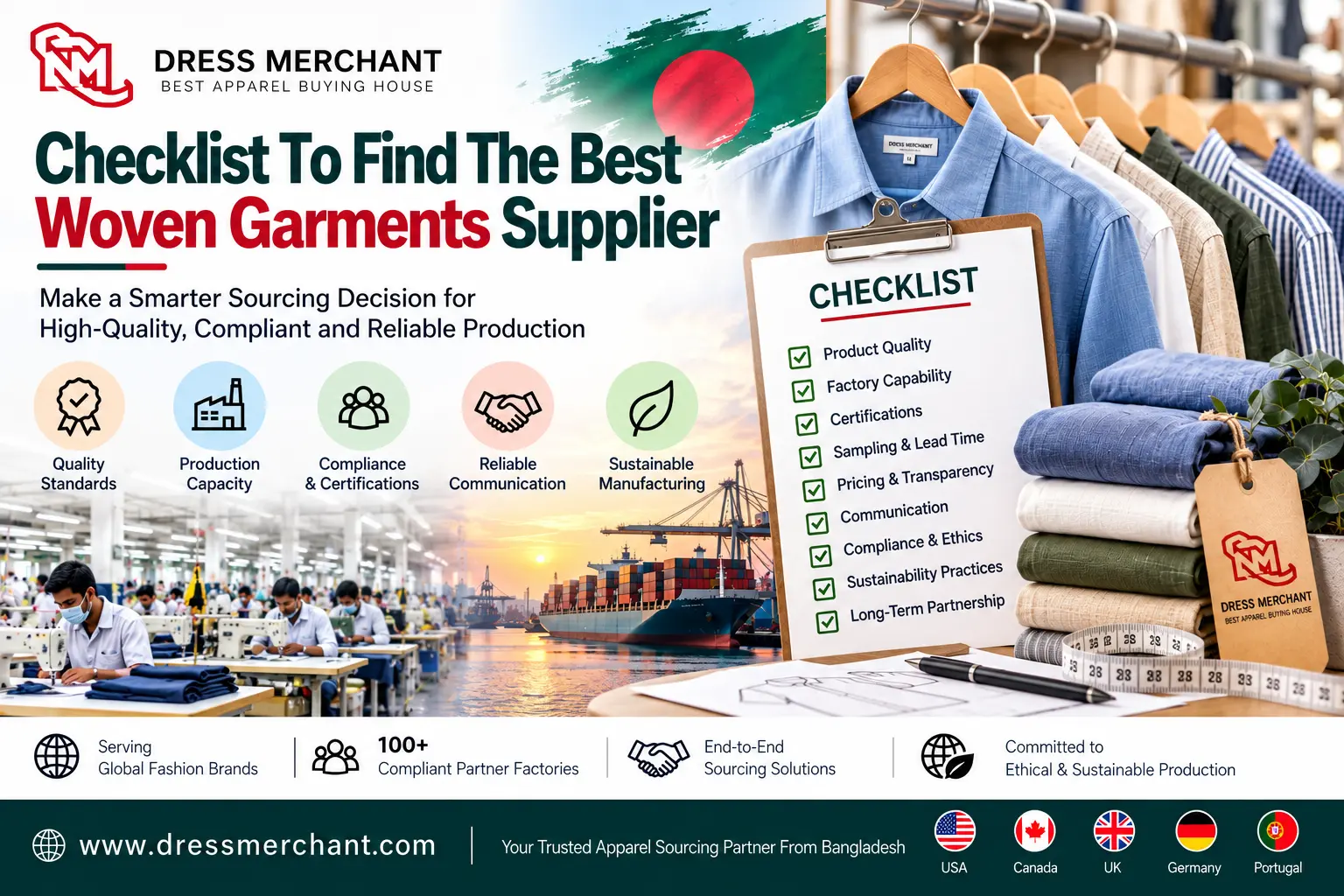
Checklist To Find The Best Woven Garments Supplier—discover the essential factors for choosing a reliable partner for quality, pricing, compliance, production capacity, and timely delivery.
Thank you for reading this post, don't forget to subscribe!Dress Merchant, a leading Garments Buying House and fashion buying agent in Bangladesh, helps international buyers source, produce, and export high-quality woven apparel and home textiles with confidence. Make smarter sourcing decisions and build a dependable supply chain with the right supplier.
1. Check the Supplier’s Experience in Woven Garment Manufacturing
Experience is one of the first things international buyers should evaluate when selecting a woven garments supplier in Bangladesh. A supplier with years of experience is generally more familiar with international quality standards, production requirements, buyer expectations, and export procedures.
Before placing an order, ask the supplier how long they have been manufacturing woven garments and what types of products they specialize in. Their experience should ideally match the products you are looking to source, such as shirts, blouses, dresses, trousers, jackets, skirts, uniforms, or other woven apparel.
It is also useful to check whether the supplier has experience working with international brands, retailers, wholesalers, or sourcing companies. Previous export experience can indicate that the manufacturer understands international specifications, packaging requirements, inspection procedures, documentation, and shipment deadlines.
Do not simply choose a supplier because they claim to have extensive experience. Ask for evidence, product references, factory information, certifications, or examples of previous production. A reliable woven garment supplier should be comfortable explaining its capabilities and production background.
For new buyers, working with an experienced Bangladesh apparel sourcing partner can also reduce the challenges of identifying and communicating with suitable manufacturers.
2. Verify Product Quality and Fabric Standards
Product quality should be one of the most important items on your supplier evaluation checklist. A competitive price is not beneficial if the finished garments fail to meet your required fabric, construction, measurement, color, or finishing standards.
When evaluating a woven garments supplier, clearly communicate your product specifications. These may include fabric composition, GSM, weave type, yarn count, color standards, shrinkage requirements, colorfastness, measurements, stitching specifications, trims, labels, and finishing details.
Request fabric swatches and samples before confirming bulk production. A pre-production sample allows you to evaluate the actual workmanship and compare it with your technical specifications.
International buyers should also ask how the supplier controls fabric and garment quality throughout production. Important checkpoints may include fabric inspection, cutting, sewing, inline inspection, finishing, measurement checking, and final inspection.
A professional woven garment manufacturer should have a structured quality management process rather than relying only on a final inspection. Consistent quality is particularly important for buyers supplying international retailers and brands, where even small deviations can result in customer complaints, returns, or shipment delays.
3. Evaluate Production Capacity and Order Flexibility
Production capacity is another important factor when choosing a woven garments supplier in Bangladesh. A manufacturer may produce excellent samples but still struggle to handle your required bulk quantity within the agreed deadline.
Ask about the supplier’s monthly production capacity and determine whether it is suitable for your order volume. You should also understand which types of woven garments the factory is equipped to manufacture and whether it has the necessary machinery and production lines.
Capacity should not be evaluated based solely on the number of garments a factory claims to produce. Consider whether the manufacturer can maintain consistent quality while handling your order and whether sufficient production resources are available during peak seasons.
Order flexibility is equally important for new international buyers. You may initially require a relatively small quantity while testing a new product or market. Therefore, ask about the supplier’s minimum order quantity (MOQ), size and color flexibility, sampling options, and ability to accommodate repeat orders.
A supplier that can support both initial orders and future volume increases can become a valuable long-term sourcing partner.
4. Review Certifications and Factory Compliance
Factory compliance is an essential consideration for international buyers sourcing woven garments from Bangladesh. A manufacturer should be able to demonstrate that its operations meet applicable legal, ethical, environmental, and workplace requirements.
Depending on your target market and buyer requirements, relevant certifications or compliance documentation may include quality management, social compliance, environmental management, chemical safety, or product-specific certifications.
Do not assume that every certification is automatically relevant to your business. Instead, identify the requirements of your customers and destination markets and confirm whether the supplier can meet them.
You should also ask whether the factory maintains appropriate documentation and whether third-party audits have been conducted. If your business supplies major retailers or brands, social and ethical compliance may be an essential part of supplier approval.
A reliable woven garments manufacturer should be transparent about its factory location, production facilities, compliance status, certifications, and audit history.
For new buyers, supplier verification is especially important because it can help reduce the risk of working with an unsuitable manufacturer or an intermediary that cannot deliver the required production standards.
5. Assess Quality Control and Inspection Procedures
A strong quality control system can make a significant difference to the success of an international garment order. Before selecting a woven garments supplier, ask how quality is monitored from fabric sourcing through final shipment.
A professional manufacturer may use multiple inspection stages, including raw material inspection, fabric inspection, cutting inspection, inline quality control, finishing inspection, measurement checking, and final random inspection.
Ask whether the supplier has dedicated quality control personnel and how quality issues are documented and corrected. You should also understand how the factory handles defects discovered during production.
For international buyers, it is important to establish clear quality standards before bulk manufacturing begins. Your purchase order or technical package should specify measurements, tolerances, fabric requirements, construction details, approved samples, packaging instructions, and other critical specifications.
Third-party inspection can also be considered when appropriate, particularly for new supplier relationships or high-volume orders.
Choosing a supplier with a systematic quality assurance process gives buyers greater confidence that the bulk order will remain consistent with the approved sample and technical requirements.
6. Check the Supplier’s Sampling and Product Development Process
Sampling is an important stage in woven garment sourcing because it allows buyers to identify potential problems before committing to bulk production.
When evaluating a woven garments supplier, ask about its sample development process. A capable manufacturer should be able to understand your tech pack, measurement chart, fabric requirements, artwork, trims, labels, and construction instructions.
Depending on the product, you may require several stages of sampling, including development samples, fit samples, size sets, pre-production samples, or approval samples.
Pay attention to how the supplier responds to your comments. If you request changes to measurements, fabric, stitching, buttons, labels, or finishing, the manufacturer should be able to implement those changes accurately.
Sample quality can also provide valuable insight into the factory’s production capabilities. If a supplier struggles to follow specifications during sampling, it may be risky to proceed directly to large-scale production.
For first-time buyers, a structured sampling process provides an opportunity to evaluate the supplier before placing a substantial bulk order.
7. Compare Pricing, MOQ, and Payment Terms
Price is naturally an important consideration when selecting a woven garment supplier, but international buyers should avoid choosing a manufacturer based only on the lowest quotation.
When comparing suppliers, request detailed quotations based on the same specifications. Differences in fabric quality, trims, construction, packaging, testing, and finishing can significantly affect the final garment price.
Ask suppliers to clarify their minimum order quantity (MOQ), sample charges, production costs, payment terms, packaging costs, and any other applicable charges. Make sure you understand whether the quoted price includes all required components and services.
It is also important to compare quotations on an equal basis. A lower price may not represent better value if it comes with inferior fabric, inconsistent quality, longer lead times, or inadequate quality control.
For new international buyers, transparent communication about commercial terms can prevent misunderstandings later in the sourcing process.
The best supplier is usually not the cheapest supplier. Instead, look for a manufacturer that offers a reasonable balance of quality, price, production capability, compliance, communication, and delivery reliability.
8. Evaluate Lead Times and On-Time Delivery Performance
Meeting delivery deadlines is critical in international apparel sourcing. Late shipment of woven garments can affect retail launches, seasonal collections, promotional campaigns, and customer commitments.
Before placing an order, ask the supplier to provide realistic timelines for sampling, fabric procurement, production, inspection, finishing, and shipment preparation.
Do not evaluate lead time based only on the supplier’s best-case estimate. Discuss potential delays caused by fabric availability, approval cycles, public holidays, production congestion, or changes to specifications.
It is also useful to ask about the manufacturer’s previous experience with export orders and whether it has a record of meeting agreed shipment schedules.
A professional supplier should communicate quickly if an unexpected production issue could affect the delivery date. Early communication gives the buyer an opportunity to adjust the production or logistics plan.
When comparing woven garments suppliers in Bangladesh, delivery reliability should therefore be considered alongside price and quality. A slightly higher production cost may be worthwhile if it significantly reduces the risk of costly delays.
9. Review Export Experience and International Market Expertise
A supplier’s ability to manufacture garments is only one part of successful international sourcing. Export experience is equally important for buyers purchasing woven apparel from Bangladesh.
Ask whether the supplier regularly exports to your target market, such as the USA, UK, European Union, Canada, or other international destinations. Experience with your market can help the manufacturer understand relevant product specifications, labeling, packaging, documentation, and buyer expectations.
You should also evaluate whether the supplier understands international shipping processes and can coordinate effectively with your nominated freight forwarder, buying agent, or logistics partner.
For new buyers, working with a manufacturer that has established export experience can simplify the sourcing process. However, buyers should still conduct appropriate supplier verification and establish clear contractual and quality requirements.
This is where an experienced apparel buying house or sourcing agent can provide additional value. A professional sourcing partner can help international buyers identify suitable factories, compare suppliers, communicate specifications, coordinate samples, monitor production, and support quality control.
10. Check Communication, Customer Service, and After-Sales Support
Clear communication is often underestimated when selecting a woven garments supplier. However, international apparel orders involve many details, and poor communication can quickly lead to misunderstandings.
Evaluate how promptly and professionally the supplier responds to your inquiries. Do they understand your technical requirements? Can they explain production limitations clearly? Do they provide accurate quotations and realistic timelines?
You should also consider who will manage your account throughout the order. A dedicated merchandising or customer service team can make communication easier, particularly when dealing with multiple styles, colors, sizes, fabrics, and delivery schedules.
Good suppliers should also be willing to address problems after shipment when necessary. Ask how they handle quality claims, production discrepancies, replacement requirements, or other commercial issues.
For a new international buyer, the ideal woven garments supplier is not simply a factory that can produce your order. It should be a dependable business partner capable of communicating clearly, solving problems, maintaining quality, and supporting your long-term sourcing requirements.
A structured supplier evaluation process can help buyers move beyond price-based sourcing and identify manufacturers that offer dependable quality, transparent communication, and sustainable business relationships.
Conclusion: Checklist To Find The Best Woven Garments Supplier
Finding the best woven garments supplier requires more than comparing prices. Buyers should carefully evaluate product quality, manufacturing capabilities, production capacity, compliance, certifications, lead times, quality control systems, communication, and export experience before making a sourcing decision. A reliable supplier should be able to consistently deliver high-quality woven garments while meeting international standards, agreed specifications, deadlines, and ethical sourcing requirements.
For international buyers, working with an experienced apparel buying house and sourcing partner can make this process easier, safer, and more efficient. Dress Merchant is a professional apparel buying house and apparel buying agent in Bangladesh, providing end-to-end sourcing, manufacturing, quality control, and export support for global buyers. With access to reliable manufacturing partners and experience in apparel and textile sourcing, Dress Merchant helps buyers identify suitable woven garments suppliers based on their product requirements, target market, quality expectations, and budget.
By following a comprehensive supplier checklist and partnering with a dependable sourcing company like Dress Merchant, international buyers can reduce sourcing risks, maintain consistent quality, achieve competitive pricing, and build long-term supplier relationships. The right woven garments supplier is not simply the one offering the lowest price—it is the partner that delivers quality, reliability, compliance, flexibility, and long-term value.