Affordable Woven Clothing Manufacturers For Bulk Orders—partner with Dress Merchant for reliable, cost-effective woven apparel sourcing in Bangladesh. As a leading Garments Buying House and fashion buying agent, we specialize in sourcing, production, quality control, and export of premium Apparel and Home Textiles. Get competitive pricing, flexible bulk-order solutions, dependable production, and seamless global delivery for your next collection.
Thank you for reading this post, don't forget to subscribe!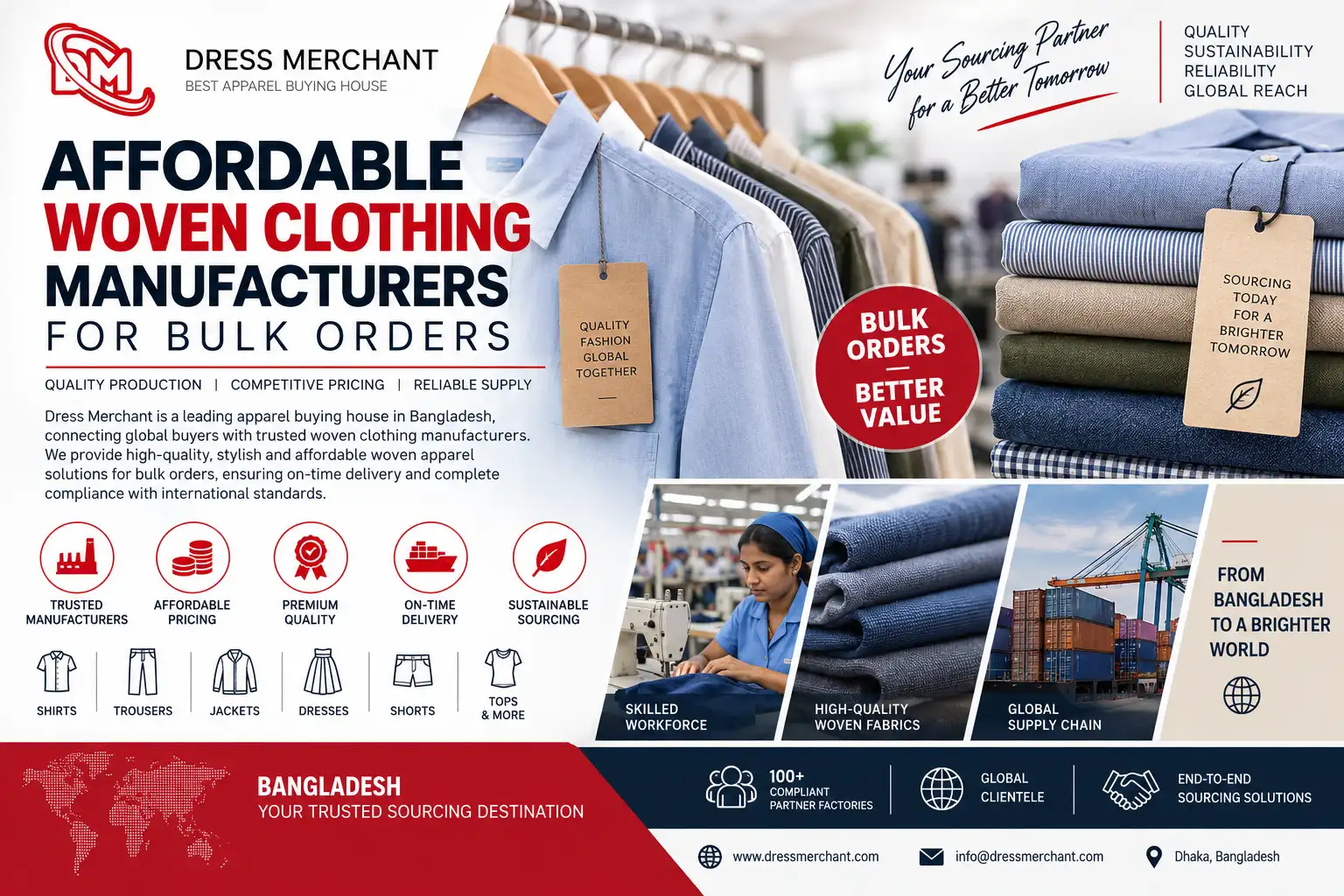
Why Choose Affordable Woven Clothing Manufacturers for Bulk Orders?
Finding the right manufacturing partner is essential for brands, wholesalers, retailers, and fashion businesses that need large quantities of clothing at competitive prices. Affordable woven clothing manufacturers for bulk orders can help buyers control production costs while maintaining consistent quality, reliable delivery schedules, and professional manufacturing standards. Woven garments are widely used across the global fashion industry because they offer versatility, durability, and excellent opportunities for customization.
One of the biggest advantages of working with an affordable manufacturer is cost efficiency. When clothing is produced in bulk, manufacturers can purchase fabrics, trims, labels, buttons, packaging materials, and other components in larger quantities. This helps reduce the average production cost per garment. Buyers can therefore achieve more competitive wholesale pricing while maintaining their desired product specifications.
Affordable does not necessarily mean low quality. Experienced woven clothing manufacturers understand the importance of balancing price with fabric quality, workmanship, finishing, and quality control. They can work with buyers to select appropriate fabrics and production techniques according to the target market and budget. This is particularly important for international buyers who need products that meet specific quality and compliance requirements.
Bulk manufacturing also provides greater flexibility. Buyers can order different styles, colors, sizes, and designs according to their market requirements. Manufacturers with experienced production teams can support product development, sampling, pattern making, cutting, sewing, washing, finishing, inspection, and packaging.
For international apparel buyers, choosing the right manufacturing partner can also simplify the sourcing process. A professional manufacturer or buying house can coordinate multiple stages of production and communication, reducing unnecessary complications.
Ultimately, affordable bulk woven clothing manufacturing is about achieving the right combination of competitive pricing, consistent quality, production capacity, customization, and dependable delivery. Businesses that carefully evaluate manufacturers before placing large orders can build long-term sourcing relationships and improve their overall apparel supply chain.
Top Benefits of Sourcing Woven Clothing in Large Quantities
Sourcing woven clothing in large quantities can provide significant advantages for fashion brands, wholesalers, retailers, importers, and private-label businesses. When buyers work with experienced affordable woven clothing manufacturers for bulk orders, they can often achieve better pricing while gaining access to professional production capabilities.
The first major benefit is lower unit cost. Bulk production allows manufacturers to spread setup, labor, material, and operational expenses across a larger number of garments. As production volume increases, the cost per piece can become more competitive. This makes bulk sourcing particularly attractive to wholesalers and retailers that need healthy margins.
Another important benefit is consistent product quality. Professional manufacturers establish standardized production processes for cutting, sewing, finishing, measurement, and inspection. Producing a large quantity under the same specifications can help maintain consistency between individual garments and production batches.
Bulk orders also provide greater opportunities for customization. Buyers can request specific fabrics, colors, prints, embroidery, buttons, labels, packaging, measurements, and other design details. This allows brands to develop products that match their identity and target market rather than relying exclusively on ready-made clothing.
Large-scale sourcing can also improve inventory availability. Retailers and wholesalers need sufficient stock to satisfy customer demand, particularly during seasonal campaigns or major sales periods. A reliable manufacturing partner can help buyers plan production according to expected demand and delivery schedules.
Another advantage is supply-chain efficiency. Instead of working with multiple small suppliers for different products, buyers may consolidate several styles or product categories with one capable manufacturing partner. This can simplify communication, quality control, documentation, and shipment coordination.
However, buyers should carefully evaluate minimum order quantities, production capacity, lead times, quality assurance procedures, certifications, fabric sourcing capabilities, and export experience before placing a bulk order.
With proper planning, bulk woven clothing sourcing can help businesses achieve competitive pricing, consistent quality, efficient inventory management, and stronger control over their apparel collections.
How to Find Reliable and Affordable Woven Clothing Manufacturers
Finding a manufacturer that combines affordability with reliability requires more than simply comparing quotations. Businesses searching for affordable woven clothing manufacturers for bulk orders should evaluate several important factors before making a sourcing decision.
Start by examining the manufacturer’s production capabilities. Buyers should determine whether the company has experience producing the specific woven garments they require, such as shirts, blouses, dresses, trousers, skirts, jackets, overshirts, uniforms, or children’s clothing. Relevant manufacturing experience can help reduce production errors and improve communication during product development.
Production capacity is another important consideration. A manufacturer may offer attractive pricing but may not have sufficient capacity to handle a large order within the required deadline. Buyers should ask about monthly production capacity, current production schedules, machinery, workforce, and expected lead times.
Quality control should also receive significant attention. Reliable manufacturers generally have inspection procedures covering fabric quality, measurements, stitching, color consistency, finishing, and packaging. Buyers can request information about their quality-control process and, where appropriate, arrange pre-production samples or inspections.
Price comparison is useful, but the cheapest quotation should not automatically be considered the best option. Buyers should compare the complete cost structure, including fabric, trims, labor, printing, embroidery, labels, packaging, transportation, and other applicable expenses.
Communication is equally important. International buyers should choose manufacturers that can clearly understand technical specifications, measurement charts, tech packs, sample requirements, and production instructions.
It is also helpful to review references, previous export experience, certifications, factory compliance information, and sample quality before confirming a major order.
For buyers sourcing from Bangladesh, working through an experienced apparel sourcing company or buying house can provide additional support. Such partners can help identify suitable factories, negotiate pricing, coordinate samples, monitor production, and manage communication.
A systematic evaluation process allows buyers to identify manufacturers that offer a practical balance between affordability, quality, capacity, communication, and delivery reliability.
Affordable Woven Garment Manufacturing Solutions for International Buyers
International apparel buyers often need manufacturing solutions that combine competitive pricing with dependable production and consistent quality. This is where professional affordable woven clothing manufacturers for bulk orders can provide valuable support to global brands, retailers, wholesalers, importers, and private-label companies.
Woven garment manufacturing involves multiple stages, including fabric sourcing, product development, pattern preparation, cutting, sewing, finishing, inspection, labeling, packaging, and shipment preparation. An experienced manufacturing partner can coordinate these stages according to the buyer’s specifications and target price.
One of the most important requirements for international buyers is flexibility. Different markets have different consumer preferences, sizing systems, fabric requirements, labeling regulations, and design trends. A capable manufacturer should be able to adapt production according to these requirements.
Cost management is another major consideration. Manufacturers can help buyers identify suitable fabrics and trims that meet the desired quality level without unnecessarily increasing production costs. Bulk purchasing of raw materials can also contribute to competitive pricing.
Product development support can be particularly valuable for brands launching new collections. Buyers may provide sketches, reference samples, technical drawings, or tech packs, while experienced production teams transform those concepts into physical samples. After approval, the manufacturer can proceed to bulk production.
International buyers also need reliable quality assurance. Production inspections at different stages can help identify issues before the garments are packed and shipped. This can reduce the risk of receiving large quantities of products that do not meet the approved specifications.
Bangladesh has developed a strong apparel manufacturing ecosystem with numerous factories, suppliers, textile facilities, and supporting industries. Buyers working with professional sourcing partners can access this ecosystem while receiving assistance with factory selection, production coordination, quality control, and shipment planning.
For global buyers, an effective manufacturing solution is not simply about obtaining the lowest price. It is about achieving a practical combination of cost efficiency, product quality, customization, production capacity, compliance, and dependable delivery.
What Types of Woven Clothing Can Be Produced in Bulk?
Woven clothing covers a broad range of apparel products, making it suitable for brands and wholesalers serving different market segments. Experienced affordable woven clothing manufacturers for bulk orders can produce numerous styles according to customer requirements, fabric specifications, designs, and target markets.
Woven shirts are among the most commonly manufactured products. These can include casual shirts, formal shirts, button-down shirts, overshirts, work shirts, and fashion shirts. Buyers can customize collar styles, cuffs, buttons, pockets, stitching, colors, prints, and branding elements.
Woven dresses are another popular category. Manufacturers can produce casual dresses, summer dresses, office dresses, maxi dresses, shirt dresses, children’s dresses, and other fashion styles. Buyers can select different fabrics, silhouettes, embellishments, prints, and finishing details.
Trousers and pants are also widely produced using woven fabrics. Depending on the market, manufacturers may produce formal trousers, casual pants, cargo trousers, chino-style pants, workwear trousers, and fashion bottoms.
Other woven products include skirts, shorts, blouses, jackets, coats, vests, jumpsuits, uniforms, and workwear. Children’s and baby apparel can also be manufactured in different woven constructions and designs.
Manufacturers may work with various fabrics, including cotton, polyester, viscose, linen, denim, twill, poplin, canvas, and blended fabrics. The final fabric selection depends on the product design, season, target customer, performance requirements, and budget.
Customization is an important part of bulk manufacturing. Buyers can request specific measurements, colors, prints, embroidery, labels, buttons, zippers, hang tags, packaging, and other brand elements.
Before starting bulk production, buyers typically approve samples to confirm the design, measurements, construction, fabric, color, and finishing. This helps establish a clear production standard.
By working with a capable manufacturer, businesses can develop complete woven apparel collections rather than sourcing only individual products. This flexibility makes bulk woven manufacturing suitable for retailers, fashion brands, wholesalers, promotional businesses, and private-label companies.
How Bulk Orders Help Reduce Woven Clothing Production Costs
Bulk ordering is one of the most effective ways for apparel buyers to achieve competitive manufacturing costs. Affordable woven clothing manufacturers for bulk orders can use higher production volumes to improve operational efficiency and reduce the average cost associated with individual garments.
One important factor is raw-material purchasing. When manufacturers purchase fabric, buttons, labels, thread, packaging materials, and other components in larger quantities, suppliers may offer more competitive prices. These savings can contribute to lower overall production costs.
Bulk production also improves manufacturing efficiency. Once patterns, cutting arrangements, sewing lines, and production processes are established, manufacturers can produce larger quantities without repeating the same setup procedures for every small order. This reduces certain fixed costs on a per-piece basis.
Labor efficiency can also improve with larger production runs. Workers become familiar with the specific construction requirements of a garment, which can support faster and more consistent production. Specialized sewing lines can further improve productivity.
Shipping and packaging efficiency may provide additional savings. Buyers shipping larger quantities can potentially consolidate products into fewer shipments, depending on their logistics arrangements. This may make transportation and handling more efficient compared with multiple small shipments.
However, bulk ordering should be planned carefully. Ordering too much inventory can create storage costs and increase the risk of unsold products. Businesses should consider historical sales data, seasonal demand, market trends, and inventory turnover before confirming production quantities.
Manufacturers can also help buyers select cost-effective materials. For example, a buyer may choose a fabric blend or alternative trim that provides the required appearance and performance at a more suitable price point.
The key is to balance order quantity with actual market demand. A well-planned bulk order can provide significant cost advantages without unnecessarily increasing inventory risk.
For fashion businesses, bulk manufacturing therefore offers an opportunity to improve unit economics, production efficiency, material purchasing, and overall supply-chain performance while maintaining the required product standards.
Quality Control Standards of Affordable Woven Clothing Manufacturers
Affordability is important for bulk apparel buyers, but quality should remain a central consideration when selecting a manufacturing partner. Professional affordable woven clothing manufacturers for bulk orders understand that consistent quality is essential for building long-term relationships with international brands and buyers.
Quality control typically begins with raw-material inspection. Fabric should be checked for issues such as shade variation, weaving defects, stains, holes, GSM differences, shrinkage, and other problems depending on the product specification. Identifying material problems before cutting can reduce production waste.
The next stage involves sample and pre-production approval. Buyers can review samples to confirm fabric, measurements, construction, color, trims, labels, and finishing. The approved sample then becomes an important reference for bulk production.
During cutting and sewing, manufacturers should monitor measurements, seam construction, stitching quality, thread tension, button placement, zipper installation, pocket positioning, and other technical requirements. Production-line inspections can identify problems before they spread across a large quantity.
Finishing and final inspection are also important. Garments may be checked for loose threads, stains, pressing quality, labeling, measurements, appearance, and packaging. Depending on the buyer’s requirements, inspections may follow an agreed sampling methodology.
Documentation can also support quality consistency. Technical specifications, measurement charts, approved samples, color standards, and packaging instructions provide production teams with clear references.
International buyers may also require manufacturers to meet particular social, environmental, or product-related standards. These requirements can vary depending on the buyer, destination market, product category, and applicable regulations.
Affordable manufacturing should therefore be understood as cost-efficient manufacturing, not simply low-cost manufacturing. A supplier that delivers inexpensive garments with inconsistent quality can ultimately create higher costs through returns, complaints, rework, delayed deliveries, and damaged customer relationships.
By combining competitive pricing with structured quality control, manufacturers can help buyers receive woven garments that meet agreed specifications and market expectations.
Custom Woven Clothing Manufacturing for Wholesale and Bulk Buyers
Customization is an important requirement for modern fashion brands and wholesale businesses. Rather than purchasing generic garments, many buyers want products that reflect their brand identity, customer preferences, and market positioning. Affordable woven clothing manufacturers for bulk orders can support this requirement through customized product development and production.
Custom manufacturing can begin with a buyer’s concept. This may be a sketch, technical pack, reference garment, photograph, measurement chart, or detailed product specification. The manufacturer can use these materials to develop a sample according to the buyer’s requirements.
Fabric selection is another important part of customization. Buyers can select materials based on weight, texture, appearance, durability, comfort, seasonality, and price. Depending on the product, options may include cotton, polyester, viscose, linen, denim, twill, poplin, canvas, or blended fabrics.
Design details can also be customized. These may include collars, cuffs, sleeves, pockets, buttons, zippers, pleats, waistbands, stitching, embroidery, printing, washing effects, and decorative elements.
Branding is equally important for private-label businesses. Manufacturers can incorporate woven labels, printed labels, care labels, hang tags, badges, packaging, and other brand elements according to the buyer’s specifications.
Size and color customization allows buyers to create collections designed for specific markets. Manufacturers can work with approved size charts and color standards to maintain consistency throughout production.
Before bulk manufacturing begins, sample approval is generally an important step. Buyers can evaluate the physical sample and request adjustments before confirming the final specifications.
Custom manufacturing can be particularly useful for fashion brands, online retailers, department stores, wholesalers, uniform suppliers, and private-label businesses.
The success of a customized bulk order depends heavily on clear communication. Buyers should provide accurate specifications and approve samples carefully, while manufacturers should document the final requirements before production.
With the right manufacturing partner, custom woven apparel production can combine brand identity, design flexibility, competitive pricing, and scalable production.
Why Bangladesh Is a Leading Destination for Affordable Woven Clothing
Bangladesh has developed a significant apparel manufacturing and export industry, making it an important sourcing destination for international clothing buyers. The country’s established garment ecosystem provides access to manufacturers, textile suppliers, accessories producers, washing facilities, printing services, packaging suppliers, and logistics providers.
For buyers searching for affordable woven clothing manufacturers for bulk orders, Bangladesh can offer opportunities to source garments at competitive manufacturing costs. The country’s large apparel workforce and established production infrastructure support both basic and more specialized clothing production.
Woven garments represent an important part of Bangladesh’s apparel sector. Manufacturers produce products such as shirts, trousers, dresses, jackets, skirts, workwear, uniforms, and other woven apparel for international markets.
Another advantage is the supporting supply chain. Apparel production requires numerous components beyond fabric, including buttons, labels, zippers, hang tags, threads, packaging materials, and other accessories. Bangladesh has developed supporting industries that can help manufacturers coordinate these requirements efficiently.
International buyers may also work with buying houses and sourcing agents to simplify the supplier-selection process. These companies can help with factory sourcing, price negotiation, product development, sampling, production follow-up, quality control, and shipment coordination.
Bangladesh’s geographical position and established export infrastructure also support international apparel trade. However, buyers should still conduct appropriate supplier due diligence before placing orders.
The most suitable manufacturer will depend on factors such as product category, order quantity, target price, quality requirements, compliance expectations, lead time, and destination market.
For businesses considering Bangladesh as a sourcing destination, it is useful to compare several qualified manufacturers and evaluate their production capabilities, quality systems, previous export experience, certifications, and communication processes.
Rather than selecting a supplier solely because of price, buyers should evaluate the complete sourcing proposition. A strong manufacturing relationship can provide competitive costs, scalable production, consistent quality, customization, and supply-chain support, helping international buyers develop reliable long-term sourcing strategies.
How to Choose the Right Woven Clothing Manufacturer for Your Bulk Order
Choosing the right manufacturing partner is one of the most important decisions when placing a large apparel order. A suitable affordable woven clothing manufacturer for bulk orders should be able to meet the buyer’s requirements for price, quality, production capacity, customization, communication, and delivery.
Begin by clearly defining your product requirements. Prepare information about the garment style, fabric composition, GSM, colors, size range, measurements, trims, labels, packaging, estimated quantity, and target delivery date. A detailed technical specification helps manufacturers provide more accurate quotations.
Next, evaluate the manufacturer’s relevant experience. A factory specializing in woven shirts may not necessarily be the ideal partner for highly technical outerwear. Reviewing previous products and production capabilities can help determine whether the manufacturer is suitable for your project.
Production capacity is another critical factor. Ask whether the manufacturer can handle your required order volume within the desired timeframe. A factory with insufficient capacity may struggle with deadlines even if its initial quotation is attractive.
Quality-control procedures should also be reviewed. Buyers should understand how the manufacturer handles fabric inspection, sample approval, inline inspection, final inspection, measurement checks, and defect management.
Price comparison should consider the complete quotation rather than only the basic garment price. Buyers should clarify whether the quoted price includes fabric, trims, labels, packaging, printing, embroidery, testing, and other requested services.
Communication and responsiveness are equally important. Clear communication can prevent misunderstandings regarding designs, measurements, revisions, and delivery schedules.
For international sourcing, buyers should also investigate factory compliance, certifications, export experience, social responsibility practices, and applicable product requirements.
Before committing to a large order, requesting samples is highly recommended. The sample provides an opportunity to assess workmanship, fabric quality, measurements, construction, and finishing.
Finally, establish clear production and payment terms in writing. Documenting specifications, approved samples, quantities, prices, inspection requirements, and delivery expectations can reduce potential disputes.
By evaluating manufacturers systematically rather than focusing only on price, buyers can identify a partner capable of delivering affordable, consistent, customized, and commercially suitable woven clothing at bulk quantities.
Conclusion: Affordable Woven Clothing Manufacturers For Bulk Orders
Finding Affordable Woven Clothing Manufacturers For Bulk Orders is essential for brands, retailers, wholesalers, and international buyers looking to balance competitive pricing with quality, consistency, and reliable production. While affordability is important, successful bulk sourcing also depends on fabric quality, skilled workmanship, production capacity, quality control, ethical manufacturing, timely delivery, and efficient export support.
Dress Merchant helps global buyers simplify this process through professional sourcing, manufacturing coordination, and export services from Bangladesh. As an experienced buying agent and sourcing partner, we connect buyers with reliable manufacturing facilities capable of producing woven garments according to specific designs, fabrics, measurements, quantities, quality standards, and packaging requirements. Our approach is focused on delivering commercially viable solutions without compromising the standards expected by international buyers.
Beyond woven clothing, Dress Merchant also supports buyers looking for handicraft products and home textile solutions, working with suitable manufacturers and suppliers to develop products for international markets. From product development and material sourcing to production follow-up, quality inspection, compliance coordination, and shipment support, we provide an integrated sourcing experience.
For businesses planning large-volume woven clothing orders, choosing the right sourcing partner can make a significant difference in controlling costs, maintaining product quality, and ensuring smooth delivery. Dress Merchant is committed to helping international buyers source competitively priced, quality-focused apparel and handicraft products from Bangladesh while building reliable and long-term business relationships.