
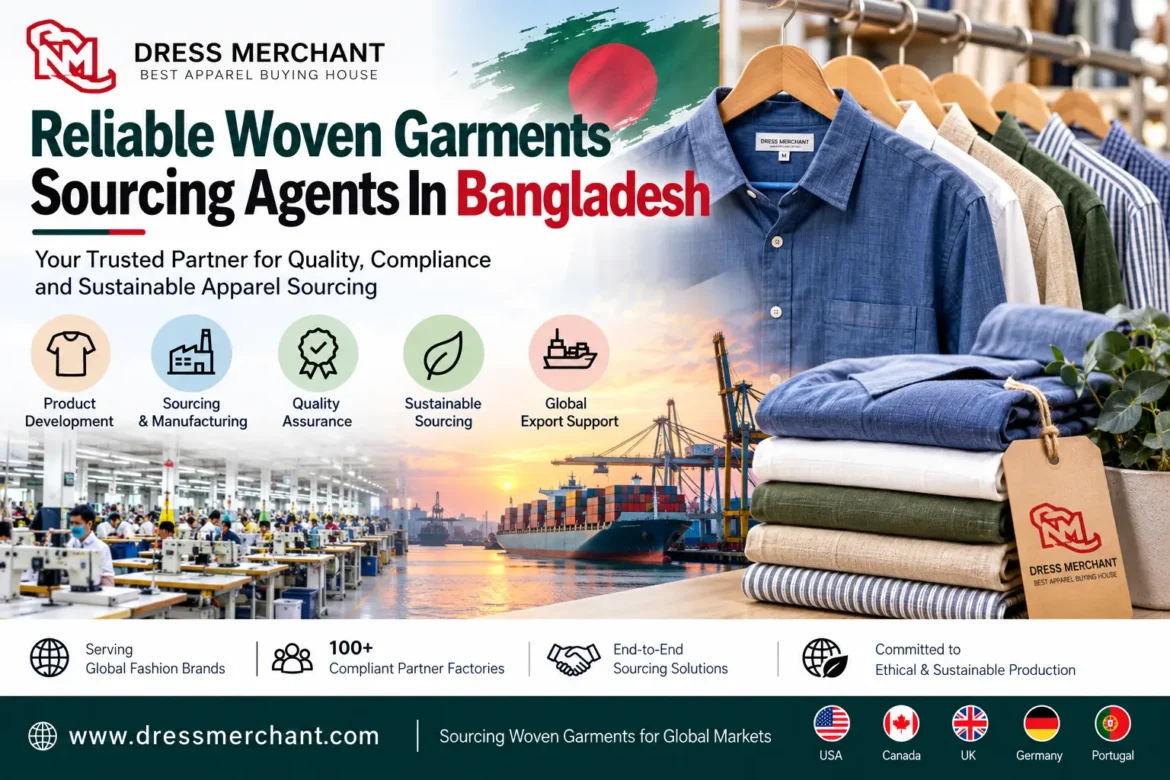
Reliable Woven Garments Sourcing Agents In Bangladesh—Dress Merchant connects global buyers with trusted manufacturers for quality woven apparel. As a leading garments buying house and fashion buying agent, we provide professional sourcing, production management, quality control, and export solutions for Apparel and Home Textiles. Partner with Dress Merchant for reliable service, competitive pricing, on-time delivery, and seamless global sourcing.
Thank you for reading this post, don't forget to subscribe!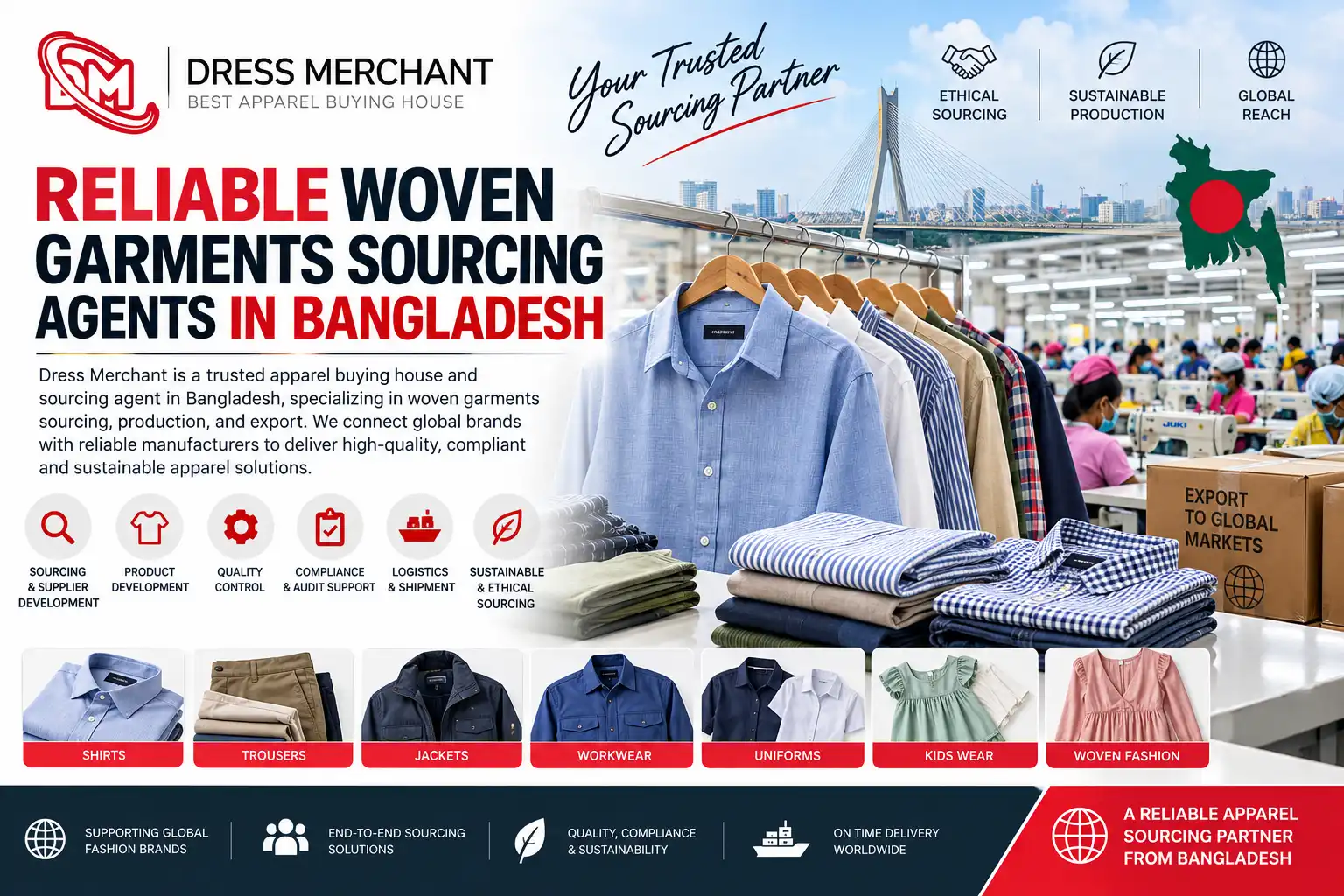
1. Why Choose Reliable Woven Garments Sourcing Agents in Bangladesh?
Bangladesh has established itself as one of the world’s important apparel sourcing destinations, particularly for buyers looking for competitive pricing, large-scale production capabilities, and diverse garment manufacturing expertise. However, sourcing directly from factories can be challenging for international buyers who are unfamiliar with the local market. This is where reliable woven garments sourcing agents in Bangladesh can provide significant value. A professional sourcing agent acts as a bridge between international buyers and suitable local manufacturers, helping coordinate the entire sourcing and production process.
Woven garments include a wide range of products such as shirts, blouses, trousers, jackets, skirts, dresses, uniforms, and other fashion apparel. Each product requires specific fabrics, trims, manufacturing techniques, quality standards, and production capabilities. An experienced sourcing agent understands these requirements and can identify factories that are appropriate for a buyer’s particular product category.
One of the major advantages of working with a sourcing agent is local market knowledge. A reputable agent can evaluate manufacturers based on production capacity, product specialization, quality systems, compliance requirements, and previous experience. This can save buyers considerable time when searching for suitable suppliers.
Sourcing agents can also support price negotiation, sample development, production follow-up, quality inspection, documentation, and shipment coordination. Their involvement can help international buyers maintain better communication with manufacturers throughout the order lifecycle.
For overseas brands, retailers, wholesalers, and importers, choosing a dependable sourcing partner can therefore simplify the procurement process. Instead of managing multiple suppliers independently, buyers can work through one experienced team that understands both international expectations and Bangladesh’s manufacturing environment.
A reliable sourcing agent ultimately helps create a more organized, transparent, and efficient sourcing experience while allowing buyers to focus on their core business activities.
2. How Woven Garments Sourcing Agents Support Global Buyers
International apparel buyers often need more than a manufacturer. They need a local partner who understands their product specifications, quality expectations, delivery schedules, communication requirements, and compliance standards. This is one of the key reasons global buyers work with reliable woven garments sourcing agents in Bangladesh.
A sourcing agent typically begins by understanding the buyer’s requirements. These may include product type, fabric composition, colors, size specifications, target price, order quantity, packaging requirements, labeling instructions, and expected delivery date. Based on this information, the agent can identify appropriate manufacturing partners.
Factory sourcing is another important responsibility. Bangladesh has numerous garment manufacturers, but not every factory is suitable for every product. A sourcing agent can help match a buyer’s requirements with factories that have the necessary machinery, skilled workforce, production capacity, and relevant product experience.
Communication is also critical. Differences in time zones, business practices, language, and technical terminology can sometimes create misunderstandings between buyers and manufacturers. A professional sourcing agent helps coordinate communication and ensures that product information is clearly transferred between both parties.
During production, the agent can monitor progress and provide updates to the buyer. They may also coordinate inspections, sample approvals, fabric approvals, production schedules, and corrective actions when necessary.
For global buyers, this local support can reduce administrative workload and make sourcing more manageable. Instead of communicating with several suppliers separately, buyers can have a dedicated sourcing partner coordinating different stages of the process.
From initial product development to final shipment, a capable sourcing agent can provide an integrated sourcing solution. This makes sourcing from Bangladesh more accessible to international brands and businesses that want to develop woven apparel products efficiently.
3. Key Services Offered by Woven Garments Sourcing Agents in Bangladesh
The services provided by reliable woven garments sourcing agents in Bangladesh can extend far beyond simply finding a factory. A professional sourcing company can support buyers throughout the product development, manufacturing, quality assurance, and export process.
One of the first services is supplier and factory sourcing. Agents research and identify manufacturers that match the buyer’s product requirements, order quantity, quality expectations, and pricing objectives. Factory selection is particularly important because different manufacturers may specialize in different woven products.
Another important service is product development. Sourcing teams can coordinate fabric selection, trims, accessories, samples, measurements, colors, prints, embroidery, washing requirements, and other technical details. They can communicate buyer specifications to the appropriate production team.
Cost negotiation is another valuable service. Agents familiar with local manufacturing costs can communicate with factories regarding fabric, labor, trims, packaging, and other production expenses. The objective is to establish commercially viable pricing while maintaining the buyer’s required quality standards.
Production monitoring helps ensure that manufacturing progresses according to the agreed schedule. Sourcing teams may follow up on fabric procurement, cutting, sewing, finishing, packing, and other production stages.
Quality assurance is also a major part of sourcing. Depending on the buyer’s requirements, inspections may be arranged at different stages of production to identify defects or specification deviations.
Additional services can include compliance coordination, factory audits, shipment planning, export documentation, packaging supervision, and communication between buyers and suppliers.
The exact services vary from one sourcing company to another. Therefore, international buyers should clearly understand what a sourcing agent provides before beginning a business relationship. A comprehensive sourcing partner can significantly simplify the woven garment procurement process from Bangladesh.
4. How to Identify a Reliable Woven Garments Sourcing Agent in Bangladesh
Choosing the right sourcing partner is an important decision for international apparel buyers. A sourcing agent can have a significant impact on product quality, pricing, communication, production efficiency, and delivery. Therefore, buyers should carefully evaluate potential reliable woven garments sourcing agents in Bangladesh before entering into a long-term business relationship.
One of the first factors to consider is industry experience. An experienced sourcing company is generally more familiar with local manufacturers, fabric suppliers, production processes, export procedures, and common challenges within the apparel industry.
Buyers should also examine the agent’s supplier network. A strong sourcing company should have access to manufacturers capable of producing the specific woven products required by the buyer. For example, a factory experienced in shirts may not necessarily be the best choice for structured jackets or specialized trousers.
Quality management capabilities should also be evaluated. Buyers can ask how the sourcing agent manages sample approval, inline inspections, final inspections, measurement checks, workmanship standards, and corrective actions.
Another important consideration is communication and transparency. A dependable sourcing agent should provide clear information about pricing, production timelines, factory capabilities, potential risks, and order progress.
International buyers should also consider the agent’s understanding of social compliance and ethical manufacturing requirements. Depending on the buyer’s market, factories may need to meet specific standards relating to labor practices, workplace safety, environmental management, and responsible production.
References, company profiles, previous projects, certifications, and customer feedback can provide additional information when evaluating a sourcing company.
Finally, buyers should assess whether the sourcing agent understands their business goals rather than simply focusing on individual orders. A strong long-term sourcing relationship is generally built on communication, transparency, consistent quality, and mutual understanding.
5. Quality Control Standards Followed by Bangladesh Sourcing Agents
Quality control is one of the most important aspects of international garment sourcing. A product that looks attractive at the design stage can still create serious commercial problems if the finished garments do not meet the buyer’s specifications. For this reason, reliable woven garments sourcing agents in Bangladesh place considerable importance on quality management throughout production.
Quality control can begin before bulk manufacturing starts. During the sample development stage, sourcing teams can review measurements, fabric quality, colors, trims, stitching, construction details, labels, and finishing according to the buyer’s approved specifications.
Fabric inspection is another important stage. Fabric defects, shade variations, incorrect composition, or problems with GSM and construction can affect the finished garment. Identifying such issues before cutting can help reduce production problems.
During manufacturing, inline inspections can help identify defects while production is underway. Common issues may include uneven stitching, open seams, incorrect measurements, loose threads, fabric defects, incorrect labeling, or workmanship problems.
A final inspection is generally conducted after garments have been completed and packed. The inspection can cover appearance, measurements, workmanship, labeling, packaging, quantity, and other buyer-specific requirements.
Professional sourcing teams may also maintain inspection reports and communicate identified issues to the factory. If problems are discovered, corrective action can be requested before shipment.
However, quality control requirements differ between buyers and markets. Some customers may have their own inspection protocols, testing requirements, approved inspection agencies, or quality manuals. A sourcing agent should therefore be able to adapt its quality management process to the buyer’s requirements.
Effective quality control is not simply about rejecting defective products. It is about identifying potential problems early, communicating clearly with manufacturers, and maintaining consistency throughout production.
6. Access to Trusted Woven Garment Manufacturers and Factories
One of the biggest advantages of working with an experienced sourcing agent is access to an established network of garment manufacturers. For international buyers unfamiliar with Bangladesh’s apparel industry, finding the right factory independently can require significant time and research. Reliable woven garments sourcing agents in Bangladesh can simplify this process by connecting buyers with manufacturers that match their requirements.
Bangladesh has a diverse manufacturing ecosystem. Different factories may specialize in different product categories, order quantities, fabrics, construction techniques, price levels, and production methods. Some manufacturers may focus on basic shirts and trousers, while others have experience with fashion garments, outerwear, uniforms, workwear, or complex woven products.
A professional sourcing agent can evaluate these differences before recommending suppliers. Factory selection may consider production capacity, machinery, workforce, technical expertise, quality systems, compliance, lead times, and previous export experience.
This supplier-matching process can be particularly useful for smaller and medium-sized international brands. Such businesses may not have an extensive sourcing department or established factory network in Bangladesh.
Sourcing agents can also help buyers avoid selecting a manufacturer solely because of a low quoted price. The lowest quotation does not always represent the most suitable commercial option. Production capability, quality consistency, communication, delivery performance, and compliance can also influence the overall value of a supplier.
Once a suitable factory has been identified, the sourcing agent can coordinate communication between the buyer and manufacturer. This may include sending technical packs, arranging sample development, discussing pricing, confirming production capacity, and following up on timelines.
A strong factory network therefore gives buyers greater flexibility when developing woven apparel collections. Instead of being dependent on a single manufacturer, they can potentially access multiple suitable production partners according to their product and business requirements.
7. Cost-Effective Woven Garments Sourcing and Production Management
Cost management is an important consideration for international apparel buyers. However, effective sourcing is not simply about finding the cheapest factory quotation. It involves balancing product quality, manufacturing costs, lead times, materials, compliance, and overall supply-chain efficiency. This is where reliable woven garments sourcing agents in Bangladesh can provide valuable support.
A sourcing agent with strong local market knowledge can help buyers understand the major components of garment pricing. These may include fabric, trims, accessories, labor, washing, printing, embroidery, packaging, transportation, and other production expenses.
During quotation analysis, the sourcing team can communicate with manufacturers and clarify cost components. If a quotation is higher than expected, the agent can discuss potential alternatives, such as fabric options, construction details, packaging methods, or production efficiencies, subject to the buyer’s approval.
Order volume can also influence manufacturing costs. Larger production quantities may provide manufacturers with greater economies of scale, while smaller orders may require different sourcing strategies. An experienced agent can help buyers identify factories whose capabilities are appropriate for their expected order volume.
Production management can also reduce avoidable costs. Delays, material shortages, incorrect samples, production errors, and late approvals can create additional expenses. Regular production follow-up can help identify potential issues earlier.
At the same time, cost reduction should not compromise required quality or ethical production standards. A responsible sourcing approach considers the complete value of the supply chain rather than focusing exclusively on the lowest initial price.
For global brands, the objective is generally to establish a commercially sustainable supply chain where product specifications, quality expectations, production schedules, and costs remain aligned. A capable sourcing agent can help coordinate these factors and make the purchasing process more efficient.
8. Sustainable and Ethical Woven Garments Sourcing in Bangladesh
Sustainability has become an increasingly important consideration for fashion brands and international apparel buyers. Modern buyers are not only interested in product appearance and price; many also want greater transparency regarding materials, manufacturing practices, environmental management, and workplace conditions. As a result, reliable woven garments sourcing agents in Bangladesh increasingly play a role in supporting responsible sourcing practices.
Sustainable woven garment sourcing can involve several areas. One is material selection. Depending on the product and buyer requirements, brands may consider recycled fibers, organic materials, responsibly sourced fabrics, or other lower-impact alternatives.
Production efficiency can also contribute to sustainability. Efficient cutting processes can help reduce fabric waste, while appropriate production planning can reduce unnecessary material consumption and rework.
Factory selection is another important consideration. Buyers may have specific expectations regarding workplace safety, labor practices, environmental management, chemical handling, wastewater treatment, and other compliance requirements. A sourcing agent can help communicate these requirements to potential manufacturing partners.
Ethical sourcing also involves transparency. Buyers increasingly want information about where their garments are produced and whether manufacturing partners meet applicable standards and customer requirements.
A sourcing agent can coordinate documentation, factory information, audits, inspections, and communication between buyers and manufacturers. However, the specific standards and certifications required depend on the buyer, product, destination market, and applicable regulations.
For fashion companies building long-term supply chains, sustainability should ideally be integrated into sourcing decisions from the beginning rather than treated as an afterthought.
Bangladesh’s established apparel manufacturing ecosystem provides international buyers with access to manufacturers working across different sustainability and compliance frameworks. With appropriate supplier selection and monitoring, sourcing agents can help buyers develop woven garment supply chains that align more closely with their responsible sourcing objectives.
9. Export, Compliance, and Logistics Support for International Buyers
Sourcing garments internationally involves much more than manufacturing. Buyers also need to consider documentation, compliance, packaging, shipment planning, customs requirements, and delivery schedules. Reliable woven garments sourcing agents in Bangladesh can help coordinate these different activities and improve communication between manufacturers and international customers.
Compliance requirements can vary according to the buyer, destination country, product category, and retailer. International brands may have specific requirements relating to factory conditions, product safety, labeling, packaging, restricted substances, social responsibility, or environmental practices.
A sourcing agent can help communicate applicable buyer requirements to manufacturers and coordinate the necessary documentation or inspections. They may also help buyers understand production and export procedures in the local market.
Logistics is another important part of the process. Once production is completed, garments need to be properly packed, documented, and prepared for shipment. Depending on the order and destination, buyers may use sea freight, air freight, or other transportation methods.
Production scheduling should also consider the expected shipping timeline. If manufacturing is delayed, the shipment may miss a planned vessel or delivery window. Regular coordination between the factory, sourcing team, logistics providers, and buyer can help reduce such risks.
Packaging requirements can also be highly specific. Buyers may require particular carton dimensions, carton markings, barcode labels, folding methods, poly bags, hang tags, or other packaging specifications.
A sourcing agent can therefore serve as a central communication point throughout these processes. While the exact responsibilities vary between sourcing companies, a well-organized agent can help connect production, quality, documentation, and logistics activities.
For overseas buyers, this local coordination can make the Bangladesh sourcing process easier to manage and provide greater visibility from order placement through shipment.
10. Why Bangladesh Is a Strategic Destination for Woven Garments Sourcing
Bangladesh has become an important sourcing destination for international apparel companies due to its established garment manufacturing ecosystem, experienced workforce, supplier network, and export-oriented production infrastructure. For companies interested in woven apparel, the country offers access to manufacturers producing a broad range of products for international markets.
Woven garments represent a significant part of the apparel industry and include shirts, trousers, dresses, skirts, jackets, uniforms, workwear, and many other categories. Manufacturers in Bangladesh serve buyers with different product specifications, order volumes, price points, and market requirements.
Another advantage is the availability of supporting industries. Apparel manufacturing depends on fabrics, trims, labels, buttons, packaging materials, washing facilities, printing, embroidery, logistics, and other services. A developed supply-chain ecosystem can help manufacturers coordinate different production requirements.
For international buyers, working with reliable woven garments sourcing agents in Bangladesh can make this ecosystem easier to navigate. Instead of independently researching manufacturers and coordinating multiple suppliers, buyers can work with a local sourcing partner familiar with the market.
Bangladesh can also provide opportunities for buyers seeking competitive manufacturing costs while maintaining defined quality and compliance requirements. However, the suitability of Bangladesh depends on each buyer’s product, quantity, price expectations, quality requirements, lead time, and sourcing strategy.
A professional sourcing approach begins by identifying the right manufacturing partners rather than assuming that every factory will be suitable for every product. This is where local expertise can become particularly valuable.
For brands, retailers, wholesalers, and importers exploring woven apparel production, Bangladesh can therefore be an important sourcing market. With appropriate supplier selection, quality management, production monitoring, and logistics coordination, international buyers can build structured sourcing relationships with Bangladeshi garment manufacturers.
Conclusion: Reliable Woven Garments Sourcing Agents In Bangladesh
Choosing reliable Woven Garments Sourcing Agents In Bangladesh can make a significant difference in the success of your apparel business. From identifying suitable manufacturers and negotiating competitive prices to maintaining quality standards, managing production, and coordinating timely exports, an experienced sourcing partner can simplify the entire supply chain. Bangladesh’s strong manufacturing capabilities, skilled workforce, competitive production costs, and established export infrastructure make it an attractive sourcing destination for international buyers.
For brands and retailers looking for dependable sourcing support, Dress Merchant provides comprehensive apparel sourcing and buying services designed around quality, transparency, and customer requirements. As an experienced apparel buying agent and sourcing company in Bangladesh, Dress Merchant helps international clients connect with suitable manufacturers, manage product development, monitor production, and coordinate export processes efficiently.
Beyond apparel, Dress Merchant also supports handicraft sourcing, manufacturing, and export, helping global buyers access quality products from reliable Bangladeshi manufacturers and suppliers. With a focus on responsible sourcing, product quality, timely communication, and long-term business relationships, Dress Merchant aims to provide a smooth and dependable sourcing experience.
Whether you are sourcing woven garments, apparel, home textiles, or handicraft products, working with the right Bangladesh-based sourcing partner can help reduce supply-chain challenges while creating opportunities for sustainable business growth. Dress Merchant is committed to serving international buyers with professional sourcing solutions and dependable support from product development to final export.