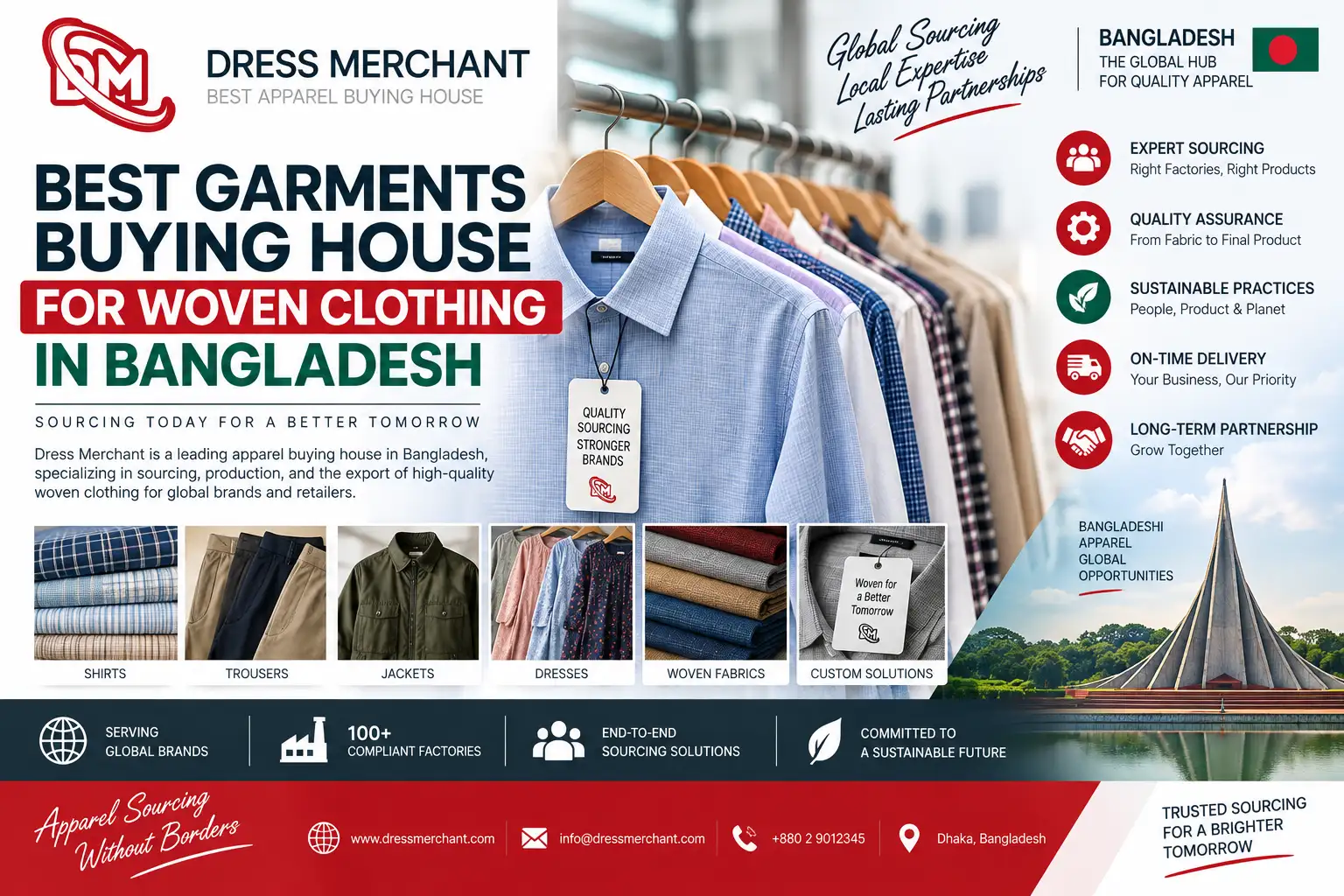
Best Garments Buying House For Woven Clothing In Bangladesh—Dress Merchant delivers reliable apparel sourcing, production, and export solutions for global fashion brands.
Thank you for reading this post, don't forget to subscribe!As a trusted fashion buying agent, we specialize in woven clothing, apparel, and home textiles, connecting buyers with quality manufacturers, competitive pricing, efficient production, strict quality control, and on-time delivery. Partner with Dress Merchant for seamless, professional, and sustainable sourcing from Bangladesh.
Why Choose a Garments Buying House for Woven Clothing in Bangladesh?
Bangladesh has established itself as one of the world’s important apparel sourcing destinations, and woven clothing is a major part of its garment manufacturing industry. For international fashion brands, retailers, wholesalers, and importers, working with a professional garments buying house can make the sourcing process more organized, efficient, and reliable. A buying house acts as a bridge between international buyers and suitable garment manufacturers, helping coordinate everything from product development and factory selection to quality control and shipment.
Woven garments include a broad range of products such as shirts, blouses, dresses, trousers, skirts, jackets, uniforms, and fashion wear. Because these products often require precise fabric selection, construction, finishing, and workmanship, buyers benefit from having an experienced local sourcing partner who understands the manufacturing environment in Bangladesh.
A professional buying house can help international clients identify appropriate factories according to product type, order quantity, quality requirements, compliance standards, and target pricing. Instead of communicating separately with multiple factories, buyers can coordinate through one experienced sourcing partner. This can simplify communication and reduce the complexity associated with international production.
Another important advantage is local knowledge. A Bangladesh-based buying house understands local suppliers, production capabilities, fabric markets, accessory suppliers, manufacturing lead times, and export procedures. This knowledge can help buyers make informed sourcing decisions.
For buyers searching for the Best Garments Buying House For Woven Clothing In Bangladesh, the most important considerations should include sourcing capability, quality management, transparent communication, factory relationships, compliance awareness, production monitoring, and export coordination. A capable buying house can transform a complicated sourcing process into a structured and manageable supply chain while helping international buyers develop quality woven clothing for their target markets.
What Makes the Best Garments Buying House for Woven Clothing in Bangladesh?
Choosing the right buying house is an important decision for international apparel buyers. A reliable buying house should offer more than simply connecting a buyer with a garment factory. It should provide comprehensive sourcing and production support throughout the entire order lifecycle.
One of the most important characteristics is strong factory sourcing capability. Different woven products require different manufacturing expertise. A supplier specializing in casual shirts may not necessarily be the right choice for tailored jackets or sophisticated women’s dresses. An experienced buying house should understand these differences and identify factories according to the technical and commercial requirements of each order.
Quality assurance is another critical factor. The buying house should have a structured quality-control process covering fabric inspection, sample development, production monitoring, measurements, workmanship, finishing, packing, and final inspection. Consistent quality control can help reduce production problems and minimize the risk of rejected shipments.
Communication is equally important. International buyers need timely updates about sampling, production progress, approvals, delays, and shipment schedules. A professional sourcing partner should maintain clear communication throughout the project.
Compliance and responsible sourcing also matter increasingly to global fashion companies. Buyers often require manufacturing partners to meet specific social, environmental, workplace, and ethical standards. A knowledgeable buying house can help buyers identify suitable compliant manufacturing facilities.
Pricing transparency is another important consideration. The best sourcing relationships are built on clear quotations, realistic costing, and proper communication regarding fabrics, accessories, labor, packaging, and other production expenses.
Ultimately, a strong Garments Buying House for Woven Clothing in Bangladesh combines sourcing expertise, factory relationships, quality control, production management, communication, compliance awareness, and export coordination. These capabilities can help international buyers develop dependable and long-term apparel supply chains in Bangladesh.
Woven Clothing Sourcing Services Offered by Leading Buying Houses in Bangladesh
Woven clothing sourcing involves multiple stages, from understanding the buyer’s concept to delivering finished products. A professional buying house can coordinate these activities and provide buyers with a centralized sourcing solution.
The process often begins with product requirements. Buyers may provide technical specifications, sketches, reference samples, tech packs, fabric information, measurements, color standards, and packaging requirements. The buying house reviews these requirements and identifies suitable manufacturers based on their capabilities.
Fabric sourcing is another important part of woven garment production. Different products may require cotton, linen, polyester, viscose, denim, twill, poplin, canvas, blended fabrics, or other materials. An experienced sourcing team can help locate suitable fabrics according to quality, appearance, performance, price, and availability.
Sample development is also essential. Before bulk production begins, buyers generally require samples for evaluation and approval. The buying house can coordinate pattern development, sample sewing, fittings, corrections, and revisions between the buyer and manufacturer.
Accessory sourcing can include buttons, labels, hang tags, zippers, threads, drawcords, packaging materials, and other components. Proper coordination ensures that these materials are available before production starts.
Leading buying houses may also provide factory selection, price negotiation, order placement, production follow-up, quality inspection, shipment coordination, and documentation support. These services allow international buyers to manage multiple stages of production through one sourcing partner.
For global fashion brands and retailers, this integrated approach can save time and simplify communication. Rather than managing every supplier independently, buyers can rely on an experienced Bangladesh-based team to coordinate the manufacturing process.
Therefore, a professional woven clothing sourcing company should provide a complete service covering product development, sourcing, sampling, manufacturing coordination, quality assurance, and export support.
How Garments Buying Houses Ensure Quality in Woven Clothing Production
Quality is one of the most important considerations when sourcing woven clothing internationally. Even a competitively priced garment can create significant problems if it does not meet the buyer’s specifications. Professional garments buying houses therefore play an important role in maintaining quality throughout the manufacturing process.
Quality management typically begins during the sampling stage. Before bulk production, samples are reviewed for fabric quality, measurements, construction, stitching, appearance, color, trims, and finishing. Any discrepancies can be identified and corrected before production begins.
Fabric inspection is another important step. Woven fabrics can have issues such as shade variation, weaving defects, stains, holes, slubs, or inconsistent construction. Proper inspection can help identify potential problems before fabric enters the cutting process.
During production, quality teams may conduct inspections at different stages. Cutting, sewing, pressing, finishing, and packing should all follow the buyer’s approved specifications. Production monitoring helps identify recurring problems early rather than waiting until the entire order has been completed.
Measurement control is particularly important for woven garments. Shirts, trousers, dresses, jackets, and other products often have multiple measurement points. Professional inspection teams can compare finished garments against approved measurement specifications and tolerances.
Final inspection is another important stage before shipment. The finished goods may be checked for workmanship, measurements, fabric defects, stains, loose threads, packaging, labeling, assortment, and overall appearance.
A professional buying house can also maintain communication between the buyer and factory when quality issues arise. This helps ensure corrective actions are taken promptly.
For international buyers searching for the Best Garments Buying House For Woven Clothing In Bangladesh, a well-structured quality assurance system should be one of the primary considerations. Consistent monitoring from sample development through final shipment helps protect product quality and supports long-term buyer-supplier relationships.
Woven Garment Manufacturing and Factory Sourcing in Bangladesh
Bangladesh has a large and diverse garment manufacturing ecosystem capable of producing a wide range of woven apparel. However, selecting the right factory for a specific product requires knowledge of manufacturing capabilities, capacity, quality standards, compliance requirements, and production expertise.
A professional buying house can help international buyers identify factories according to their individual requirements. For example, a buyer sourcing casual woven shirts may need a manufacturer with strong expertise in shirt construction, while a buyer developing structured jackets may require a factory with specialized machinery and experienced technical personnel.
Factory selection should also consider order volume. Some manufacturers are equipped to handle large-scale production, while others may be better suited to smaller or more specialized orders. Matching the buyer’s requirements with the factory’s capabilities can contribute to smoother production.
Technical capability is equally important. Woven garment factories may specialize in products such as shirts, trousers, dresses, skirts, jackets, uniforms, workwear, denim products, or fashion garments. Understanding these capabilities allows sourcing professionals to recommend appropriate manufacturing partners.
A buying house can also evaluate factories based on production facilities, quality systems, compliance requirements, lead times, and previous experience with international customers. This local assessment can be valuable for overseas buyers who may not have direct knowledge of Bangladesh’s manufacturing network.
Once a factory is selected, the buying house can coordinate sampling, costing, production planning, material sourcing, quality control, and shipment arrangements. It can also maintain regular communication between the factory and international buyer.
This factory-sourcing expertise is one of the reasons global companies work with Bangladesh-based buying houses. Instead of searching for manufacturers independently, buyers can use the knowledge and local network of an experienced sourcing company to build a more organized woven garment supply chain.
Sustainable and Ethical Woven Clothing Sourcing in Bangladesh
Sustainability has become increasingly important in the global apparel industry. Fashion companies are paying greater attention to responsible manufacturing, resource efficiency, worker welfare, material choices, waste reduction, and environmental practices.
For woven clothing buyers, sustainable sourcing can begin with material selection. Depending on the product and buyer requirements, manufacturers may work with preferred fibers, recycled materials, organic materials, responsibly sourced fabrics, or other lower-impact alternatives. The appropriate choice depends on the buyer’s product specifications and sustainability objectives.
Production efficiency can also contribute to responsible manufacturing. Efficient cutting methods may reduce fabric waste, while careful production planning can minimize unnecessary material consumption. Proper inventory and production management can further reduce avoidable waste.
Ethical manufacturing is another important consideration. International buyers may require factories to follow workplace standards concerning worker safety, working conditions, wages, working hours, and other social compliance requirements. A professional buying house can help buyers identify manufacturers that meet their required standards and documentation.
Environmental management can involve areas such as wastewater management, energy efficiency, chemical handling, waste management, and responsible resource use. The exact requirements vary according to the buyer, product, destination market, and applicable standards.
A sourcing partner with sustainability awareness can help international clients communicate their requirements effectively to manufacturers. It can also coordinate documentation, factory evaluations, production monitoring, and compliance-related communication.
For companies seeking a responsible Garments Buying House for Woven Clothing in Bangladesh, sustainability should be considered as part of the overall sourcing strategy rather than as an isolated feature. Responsible sourcing can support better supply-chain transparency while helping brands align their production processes with evolving expectations in international fashion markets.
Why Global Buyers Choose Bangladesh for Woven Clothing Production
Bangladesh has become an important sourcing destination for international apparel companies because of its established garment manufacturing ecosystem, skilled workforce, supplier network, and export-oriented production infrastructure. Woven clothing represents a significant segment of this industry.
One advantage for buyers is the country’s extensive manufacturing base. International companies can source different categories of woven garments, including shirts, trousers, dresses, skirts, jackets, uniforms, workwear, and other fashion products.
Bangladesh also has a developed textile and apparel supply chain. Depending on the product, buyers can source fabrics, trims, accessories, packaging materials, and manufacturing services through established supplier networks. This integrated ecosystem can make production coordination more efficient.
Another consideration is manufacturing experience. Bangladesh’s apparel industry has extensive experience producing garments for international markets. Manufacturers and sourcing professionals are familiar with buyer specifications, technical requirements, quality procedures, inspection processes, packaging standards, and export documentation.
Cost competitiveness is also relevant to international sourcing decisions. However, price should be considered alongside quality, compliance, production capability, lead time, and supply-chain reliability. A low initial price does not necessarily represent the most appropriate sourcing solution if other requirements are not satisfied.
Bangladesh’s export-oriented apparel industry also supports international trade through established logistics and shipping networks. This helps manufacturers and buying houses coordinate shipments to different global markets.
For international fashion companies, working with a local buying house can make the sourcing process more manageable. A buying house can provide local market knowledge, factory connections, production follow-up, quality monitoring, and communication support.
As a result, Bangladesh continues to attract international buyers looking for woven clothing manufacturing and sourcing opportunities. With the support of an experienced sourcing partner, brands can explore Bangladesh’s manufacturing capabilities while maintaining greater control over product development and production requirements.
End-to-End Woven Clothing Export and Supply Chain Management
Managing an international woven clothing order involves much more than manufacturing garments. Buyers must coordinate product development, fabric sourcing, accessories, production schedules, quality inspections, packaging, documentation, and shipment. A professional buying house can help manage these interconnected activities.
The process usually begins with product development and costing. The buyer provides product specifications, and the sourcing team works with appropriate manufacturers to calculate production costs and develop samples. Once the buyer approves the samples and commercial terms, bulk production can be scheduled.
Material sourcing is then coordinated according to the approved specifications. Fabrics, buttons, labels, zippers, hang tags, threads, packaging materials, and other accessories need to be available at the appropriate production stage.
Production follow-up is essential for maintaining delivery schedules. A buying house can communicate with the factory regarding production progress, material availability, approvals, and potential delays. Regular monitoring can help identify problems before they affect the final shipment.
Quality control continues throughout production. Inspections can be performed at appropriate stages to ensure the finished garments meet the buyer’s approved specifications.
After production, the garments are packed according to the buyer’s requirements. Carton assortment, labeling, packing ratio, shipping marks, and other details may need to follow specific instructions.
Export coordination is the final stage. A professional buying house can communicate with manufacturers, logistics providers, and buyers to coordinate shipment schedules and required documentation.
This end-to-end approach gives international buyers a centralized point of communication. It can also help reduce confusion when multiple suppliers and production stages are involved.
For woven clothing importers and fashion brands, an experienced buying house can therefore provide valuable supply-chain coordination from initial product development through final export.
How a Professional Buying House Supports International Apparel Buyers
International apparel buyers often face challenges when working with overseas manufacturers, particularly when they do not have a local sourcing team. A professional buying house can provide on-the-ground support and help bridge the communication gap between buyers and manufacturers.
One of the first benefits is communication. Product requirements, technical specifications, quality expectations, delivery dates, and commercial terms must be communicated accurately. A local buying house can coordinate discussions between the buyer and factory and help clarify technical issues.
Product development is another important service. Buyers may have an initial design concept but require assistance with fabric selection, trims, construction, sampling, and manufacturing feasibility. A sourcing team can communicate these requirements to suitable manufacturers and coordinate sample development.
Cost negotiation can also be handled locally. The buying house can communicate with factories regarding fabric consumption, labor costs, accessories, packaging, production quantities, and other components of garment costing.
Production monitoring provides additional value. Buyers do not necessarily need to travel to Bangladesh for every production order when they have a reliable local team monitoring progress and reporting relevant updates.
Quality inspection is another essential area. A professional buying house can coordinate inspections and communicate any quality concerns with the factory before shipment.
International buyers may also need assistance with packaging, shipment planning, documentation, and delivery coordination. Having one local partner responsible for coordinating these areas can simplify the overall sourcing process.
For this reason, selecting a capable buying house is particularly important for companies entering the Bangladesh apparel market for the first time. The right sourcing partner can provide local knowledge while maintaining communication with the international buyer.
Ultimately, a professional buying house functions as an extension of the buyer’s sourcing team, helping coordinate the many activities required to successfully manufacture and export woven clothing from Bangladesh.
Dress Merchant: A Trusted Garments Buying House for Woven Clothing in Bangladesh
Dress Merchant is a Bangladesh-based apparel sourcing and buying house supporting international buyers with garment sourcing, product development, manufacturing coordination, quality management, and export-related services. The company works with manufacturers and suppliers to help international clients develop and source apparel according to their product specifications and commercial requirements.
For woven clothing projects, the sourcing process can involve multiple stages, including fabric sourcing, factory selection, sampling, costing, production follow-up, quality control, packaging, and shipment coordination. Dress Merchant can coordinate these activities through its local sourcing network and industry experience.
The company focuses on understanding each buyer’s specific requirements before recommending suitable production solutions. This is particularly important for woven garments because product categories can differ significantly in terms of fabric, construction, workmanship, machinery, finishing, and quality requirements.
Dress Merchant also supports broader apparel sourcing requirements, allowing buyers to coordinate different product categories through a single sourcing partner. Its approach is designed around communication, product quality, production management, and dependable supply-chain coordination.
For international fashion brands, retailers, wholesalers, and importers looking to source woven clothing from Bangladesh, working with an experienced local buying house can simplify the manufacturing process. Instead of managing every supplier independently, buyers can work with a dedicated sourcing team that coordinates with factories and suppliers on their behalf.
Dress Merchant aims to build long-term relationships with international clients by combining local manufacturing knowledge with buyer-focused sourcing services. From initial product development to final shipment, the company can help coordinate the different stages required to bring a woven clothing collection from concept to finished product.
For buyers researching the Best Garments Buying House For Woven Clothing In Bangladesh, Dress Merchant provides a professional sourcing option for apparel companies seeking manufacturing and export support from Bangladesh.
Conclusion: Best Garments Buying House For Woven Clothing In Bangladesh
Choosing the Best Garments Buying House for Woven Clothing in Bangladesh means working with a sourcing partner that understands quality, production, compliance, timelines, and international buyer expectations. Bangladesh has a strong and growing apparel manufacturing sector, making it an excellent sourcing destination for woven garments as well as handcrafted and value-added products.
Dress Merchant works as a professional sourcing agent and buying house, connecting international buyers with reliable manufacturers and exporters in Bangladesh. From product development and fabric sourcing to production coordination, quality control, compliance, packaging, and export support, our team helps simplify the complete sourcing process. Alongside woven apparel, we also support the sourcing and export of handicraft products, working with capable manufacturers to deliver products that meet buyers’ specifications and quality expectations.
For brands, retailers, wholesalers, and importers looking for dependable sourcing solutions from Bangladesh, Dress Merchant provides a practical combination of industry knowledge, supplier coordination, quality-focused production, and export support. Our goal is to build long-term partnerships by delivering consistent quality, competitive sourcing solutions, and professional service.
If you are looking for a reliable garments buying house for woven clothing in Bangladesh or a trusted sourcing agent for handicraft manufacturing and export, Dress Merchant is ready to support your next project from sourcing to shipment.